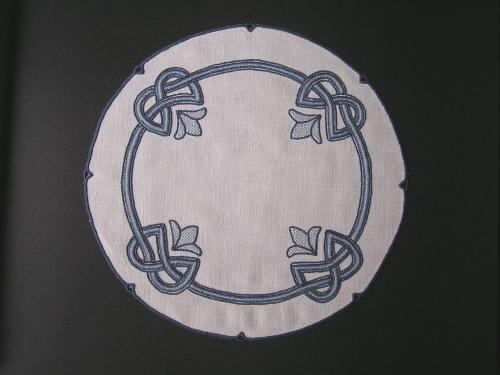
The Great Countess
Matilda of Canossa is one of those historical figures who fascinates me. She lived from 1046 - 1115. Her lands spanned across much of the central northern part of what is Italy today. She was politically active and even hosted a reconciliation between Pope Gregory VII and King Henry IV of Germany at her
castle in Canossa. She was apparently quite the military strategist as well, her forces achieving several successful campaigns. In the 1630s her remains were moved to St. Peter's Basilica in a tomb made for her by Gian Lorenzo Bernini and several other artists at the request of Pope Urban VIII.
In the 1920s Dr. Maria Bertolani Del Rio, a psychiatrist, had designs recorded from the stonework and architecture of the Canossa castle and surrounding churches. Putting them together with many Romanesque and Carolingian designs found on "Matildic codexes" (the Countess Matilda was responsible for a great many important documents and even had her own biography completed within her lifetime), a book was produced in 1935 called
Ars Canusina [Art of Canossa].
Dr. Bertolani Del Rio was the Superintendent for the
Antonio Marro scolastic colony, a project of the San Lazzaro Psychiatric Institute in Reggio Emilia. The purpose of the colony was to look after and educate children who had been admitted for psychiatric care or were abandoned by their families. Boys learned various trades and girls were taught embroidery and other textile arts.
In 1932 the colony was asked to exhibit works of local tradition in the
National Exhibition of Woman's Work. This was when Dr. Bertolani Del Rio merged her two fields of interest: the children and the designs she had been collecting. With the help of the Drawing teacher, Professor Giuseppe Baroni patterns for embroidery were created. Beautiful embroideries stitched by pupils of the colony with the assistance of a few expert embroiderers won the gold medal at the Exhibition.
The colony closed down after the Second World War and the trademarked name is now owned by the Comune of Casina and authentic products are made by the
Consorzio Ars Canusina.
Tuttoricamo has two excellent articles on the history of this technique and the colony under the "
Techniques" heading. There are also some technical instructions in the "
How its done" section.
Books on the technique include:
Reggio Ricama Racconta l'Ars Canusina, 2003 (text in Italian and English)
Ricamo Canusino, Comune di Casina (text in Italian - difficult to find)
Ars Canusina, Maria Bertolani Del Rio, 1935 (facsimile reprint 1992. Text in Italian - difficult to find)
Some examples of
Ars Canusina embroideries are
here,
here,
here,
here and
here.

 Posts