Showing posts with label Filet lace. Show all posts

Thursday, December 26, 2013

Needlework in Martina Franca, Puglia


In Martina Franca, Puglia while I was picking up some handmade pasta and local cheese to take to a friend in Ferrara I asked the shop owner if there were any handmade embroidery or lace shops in town. She told me that there was one shop with things of the 'certain quality' that I was looking for in the main square.


Simply called: Pizzi e Merletti di Nella Acquaviva [Nella Acquaviva's Laces] the shop indeed sits opposite the big fountain in Piazza Roma, no. 17. We had missed it on our way through the square because it wasn't open yet and the sign is on the inside of the big brown wooden door which covers the window when the shop is closed. We arrived breathless with excitement to find the owner of the little shop, Signora Acquaviva among a treasure trove of needlework.

Signora Acquaviva's specialty is hand-knotted netting Filet embroidery and she showed us a few sets of guest towels and curtains that she had made herself, including one towel set of pale blue linen with the most amazing padded embroidery done on ivory-coloured hand-knotted netting - it was a masterpiece!

There were also many sets of Tatted earrings done with various semi-precious stones, crystals and pearls including a lovely set with cameos made in Naples!


We discovered some exquisite Tatted sachets and Filet lace inserts which we really couldn't help ooohing and ahhhing over. The work was so fine and all done by the Signora herself.

In the shop window display was a particularly fine piece of bobbin lace done in the technique called Rosaline:

Rosaline bobbin lace in front with Filet lace on the table.
Signora Acquaviva does work on commission as well and showed us some lovely wedding favours and a breathtaking large oval Filet Lace insert ready to be attached to a floor-to-ceiling-sized curtain. If you find yourself in Martina Franca, do not miss this shop!

A huge thank you to Susan for the photos!

Saturday, May 4, 2013

Ars Aesis and Buratto Sfilato - New Book!


Giuseppa Federici's latest book is out and this time she's got a variety of things to show us! She has created some beautiful embroidery designs using a variety of stitches, some specifically from other Italian needlework techniques and others form traditional embroidery including some fascinating research which has lead her to the embroideries of Portugal.

Ars Aesis embroidery takes the Latin name for Jesi which is the town where Giuseppa Federici calls home in the Marche region of Italy. She wanted to dedicate an embroidery style to her local area and Ars Aesis features motifs of local flowers, crops and trees. Inspiration also comes from the beautiful frescos and interior decorations of the local early 19th century Villa Salvati.

Ideal fabric is listed as homespun, but if you don't have any of that handy, compact linens will work just fine. Threads used for Ars Aesis are crochet threads like DMC Babylo or Anchor Freccia. Using these threads results in lovely textured work.


Step-by-step colour photo sequences show the execution of both the embroidery stitches used and the insertion stitches used to join pieces of fabric together. There are also needle lace stitches for open areas and withdrawn thread stitches for borders, hems and framing. The how-to section is quite extensive and is an impressive 23 pages long including a section on tassels. There are over 30 motif designs.


There is a short section of the book dedicated to Buratto Sfilato (Drawn Thread Work done on contemporary Buratto fabric). A lovely Caterina de' Medici border motif is stitched around an area that is withdrawn with a pattern of a rose executed in linen stitch. While neither the Catherine de'Medici embroidery nor the linen stitch is explained, this is still a very important section. The entire withdrawn area is explained in step-by-step detailed photos showing closeups of both the back and the front of the work. There is also an edge treatment explained and if you want to learn more about Catherine de'Medici embroidery, Giuseppa Federici has written three books on it.

This book ends with a photo gallery of embroideries and a valuable bibliography to help you in further study. It is 80 pages long and the text is in Italian.

In Europe you can purchase by bank transfer directly from the author herself. Right now I'm sure she is madly getting ready for the Italia Invita Forum in Parma, so give her a few days to answer you. If you're overseas, Tombolo Disegni will be carrying it. She too is getting ready to go to the show in Parma so you may not get a reply to your email right away.

Sunday, September 30, 2012

Lace Exhibit at the Met Museum in New York


If you find yourself anywhere near the Metropolitan Museum of Art in New York before January 13, 2013, check out their Gems of European Lace exhibit at the Antonio Ratti Textile Centre!

Taken from the press release:
Included in the installation are examples of the two major lacemaking techniques: needle lace (built up from a single thread that is worked in a variety of looping, or buttonhole, stitches) and bobbin lace (woven—or braided—together from multiple threads organized on individual bobbins). Beyond the two basic technical categories, lace is also often described with the name of the town or region where a particular style was first made. The exhibition will include outstanding examples of Venetian (needle) lace, Brussels (bobbin) lace, and Devon (bobbin) lace. Of particular interest is a 19th-century handkerchief associated with King Leopold II and Queen Marie-Henriette of Belgium. The queen was a patron of the local lace industry.

There is also a lovely filet lace dress which belonged to the early 20th century American socialite Rita de Acosta Lydig an avid collector whose pieces formed the basis for the Costume Institute at the Met.

Two Italian examples in the exhibit are from the Nuttall Collection, donated by Magdalena Nuttall in 1908. You can read more about this collection by downloading the Bulletin of the Metropolitan Museum of Art, 1908.

A special thank you to Sarah for the info about this event!

Friday, June 1, 2012

Bosa Filet Lace - New book!


There are not many books on Bosa Filet Lace. In fact, there is only one that I know of which is out of print and completely unfindable (if that is a word). Imagine my excitement therefore to discover this new book which is available through the publisher Petites Ondes (free shipping until the end of June) or LuLu Print-On-Demand Books.

You can download a preview of the book (text in Italian) from the Petites Ondes page, click on "Sfoglia un'antiprima" on the right side of the page under the photo of the piece of netting mounted on a frame.

Image copyright Petite Ondes and Marina Mureddu.

The softcover book is 108 pages, printed in black and white with Italian text written by Marina Mureddu, a Sardinian woman from Cagliari which is in the southern part of Sardinia.

Signora Mureddu learned Bosa Filet Lace from the granddaughter of a famous woman from Bosa, named Olimpia Melis who achieved international fame with her Bosa Filet Lace at the beginning of the 20th century. Olimpia Melis exported works all over Europe and to New York, things like: borders, curtains, tablecloths and other household items made by several hundred Bosa Filet Lacemakers.

Over a period of several years, Marina Mureddu was able to study some of these original works and make patterns. The book contains some history, instructions, patterns and photographs.

Saturday, December 24, 2011

Circular Filet Netting

Photo copyright Filet in Tondo.

Enza Termine has updated her website and added some more photos of her exquisite Circular Filet Netting works.

There is a tutorial [in Italian but there is a Google Translate button on the website] on how to get started with Circular Filet Netting and if you were put off because you didn't know what to make besides a doiley which may not go with your home decor, browse through her galleries to be inspired for other projects!

I love her Nativity Scenes!

Photo copyright Filet in Tondo.

I hope this Holiday Season finds you exploring Italian Needlework and perhaps it is inspiring you to try new techniques in the New Year.

Thursday, July 7, 2011

Round Knotted Netting

I told you about Enza Termine of Sicily and her Round Filet Netting in this post here last year but I didn't have any photos of my own to show you her exquisite work.

That has changed, look what came in the mail today!

Hand-made knotted netting made with gold thread by Enza Termine.

Hand-made rete a rosoni [circular netting] by Enza Termine.

Today I received two pieces hand-made by Enza herself and they are marvelous! I can't stop looking at them.

Enza has a tutorial (in Italian) on her website for the art of Round Knotted Netting, and you can find an English translation of an article she wrote on the subject at Tuttoricamo, click on the British Flag for the English pages, then click on "Techniques", then "Filet and Bosa Filet", then click on the word "circular" in the fifth paragraph. There are also some great tutorials in English at Rita Bartholomew's website here. There is a bit on circular netting here.

Thank you Enza!!

Saturday, June 25, 2011

San Vero Milis

I met so many talented stitchers on my last trip to Italy. I have to tell you about a fantastic lady from San Vero Milis in Sardinia. Her name is Rossella and she invited us to her lovely home and showed us lots of her needlework of which I can only show you a few pieces today as unfortunately most of my photos did not come out well.

Rossella is curious about all kinds of embroidery and needlework and she has tried many different techniques!

Punto Madama or Catherine de' Medici Embroidery


Fantastic Macramé fringe!


These last two Filet Lace pieces are designs by Maria Lai a famous Sardinian artist who uses textiles in her art. Rossella arranged for us to meet her but I'll tell you about that in another post.

After showing us her needlework and offering us coffee and delicious typical Sardinian pastries, we all piled into our cars and drove to Bosa, for a meeting with the ladies from the association La Foce which practices the ancient art of Bosa Filet Lace. Rossella had arranged for us to visit during one of their sessions where many ladies were working on fine pieces of Bosa Filet Lace.

I wish we could have spent more time in San Vero Milis, they have lots of artisan traditions and the scenery is breathtaking. I'll have to go back!

Sunday, June 5, 2011

Filet Lace Jewelry

An interesting and attractive approach to wearable art! Filet Lace Jewelry made in Sardinia.


This necklace was a gift to me, it is hand-made Sardinian Filet Lace from Cagliari which has then been coated with fabric glue and then painted with fabric paint so it is durable and can get wet without destroying the work.

Each piece is made on a frame in the traditional Sardinian way, the Filet Lace is then embellished with coral, Swarovski crystals or other semi-precious stones and then treated with non-toxic fabric paints and glues. The hardware is made of silver or gold-plated brass or other non-nickel metals.

These Filet Lace Jewelry creations are the work of Mariangela Porcu, an embroiderer and teacher of Sardinian Filet Lace.

She makes pendants, earrings, bracelets and sets from traditional Sardinian Filet Lace as the base of the designs. All of her creations are exquisite!

Click here to see an exhibit of some of her brooches and other Filet Lace Jewelry.

While you're visiting Mariangela Porcu's website, don't miss the gallery of photos of her lovely Sardinian Filet Lace works!

Friday, January 28, 2011

Italian Almanacs

Often when I'm researching online, I lose hours and hours just browsing documents. It's always interesting and once in a while I find things relating to what I was looking for in the first place. Most often though, I find things that take me on a completely different path.

I started out looking for something on the Universal Exposition of Turin in 1911 and ended up discovering that the Internet Archive has some scanned copies of old Italian Almanacs from the beginning of the 20th century.

These are fun to browse through for the photos and advertisements if you don't read any Italian. They are like mini-encyclopedias and re-caps of the news of the past year and the events for the next year.

Sometimes there are pages of summaries of other articles from previous issues which send you on your way to check out something you missed. Key words are: moda = fashion, lavori femminili = women's work, ricamo/i = embroidery/ies, trina/e or merletto/i or pizzo/i = laces.

In the 1914 Almanac, I came across this delightful Filet lace which is hard to tell if it was executed in the Darning Stitch or the Linen Stitch:


And this intriguing needle lace called Punto Sforza:


The accompanying article is brief and talks of the many different types of embroideries and laces and of the expositions of Siena, Turin and Paris. The author expresses a desire for more of such exhibitions in Italy "so that women can be encouraged to exercise their inventive faculties, and show what their intelligence is capable of producing."

With regard to Punto Sforza, it says that it is characterized by figures in lace stitches on a background of needle lace. It looks somehow familiar to me... like I've seen it somewhere else. Off I run to my library and in Lucia Petrali Castaldi's Dizionario Enciclopedico di Lavori Femminili it says:
 ... execution derived on a variation of the Milanese Lace... hmmm. Elisa Ricci's Trine a Fuselli doesn't seem to name it but there are some photos of exquisite pieces which seem to follow the criteria in the chapter on Milanese lace... yet, I know I've seen something very close to the photo from the Almanac somewhere...


Uh, oh... how did we get to "Milan" when I started out in "Turin"?
See how it happens? How easy it is to get distracted by beautiful things?!


Ah! Let me think about this Punto Sforza for a bit and let's see if something comes back to mind. In the meantime, have a browse through the old Almanacs for a bit of early 20th century Italy flavour.

Sunday, January 9, 2011

Mezza Mandolina and Embroidered Netting

Happy New Year to everyone!
I have been occupied elsewhere lately but things are slowly returning to normal and I will get back to posting regularly soon. If you have emailed me, please be patient awhile longer, I will answer you eventually, there are many messages and only so much time to answer them.

It has come to my attention that some readers were confused as to the actual needlework technique of Mezza Mandolina and I realize that if you don't ever click on the links in the post, you will never know that it is a knotted netting.

Let's clarify a couple of things. First, if you see some words in a different colour than the rest of the text of the post or if it is underlined, that means you can click on it to go to a different website to see related photos or articles. Second, Mezza Mandolina in the post I wrote is a knotted netting technique similar to the netting made for Filet Lace (also called Lacis or Modàno).

If you look closely at this photo of Sardinian Filet Lace, you can see that at the intersection of threads there is a little knot:


When doing embroidered Filet, you must first make the netting ground. The tool used to make the netting is called the Modàno in Italian, which is why embroidered netting is often called Modàno Netting. In English it is called the shuttle. The following photo of a shuttle is from Therese de Dillmont's Needlework Encyclopedia book online:


Have a look at Therese de Dillmont's Needlework Encyclopedia book online to understand how knotted netting is made. There is also some history of Filet Netting here.

Back to Mezza Mandolina. As far as we understand from the old texts and painted portraits, Mezza Mandolina was made in the same way as Filet Lace, that is, it was a knotted netting which was then embroidered or not. Instead of making even rows of square meshes as in Filet Lace, Mezza Mandolina had several meshes which were bigger or smaller according to different patterns.

In this portrait of Eleonora di Toledo, you can see the embroidery on her blouse of Mezza Mandolina:


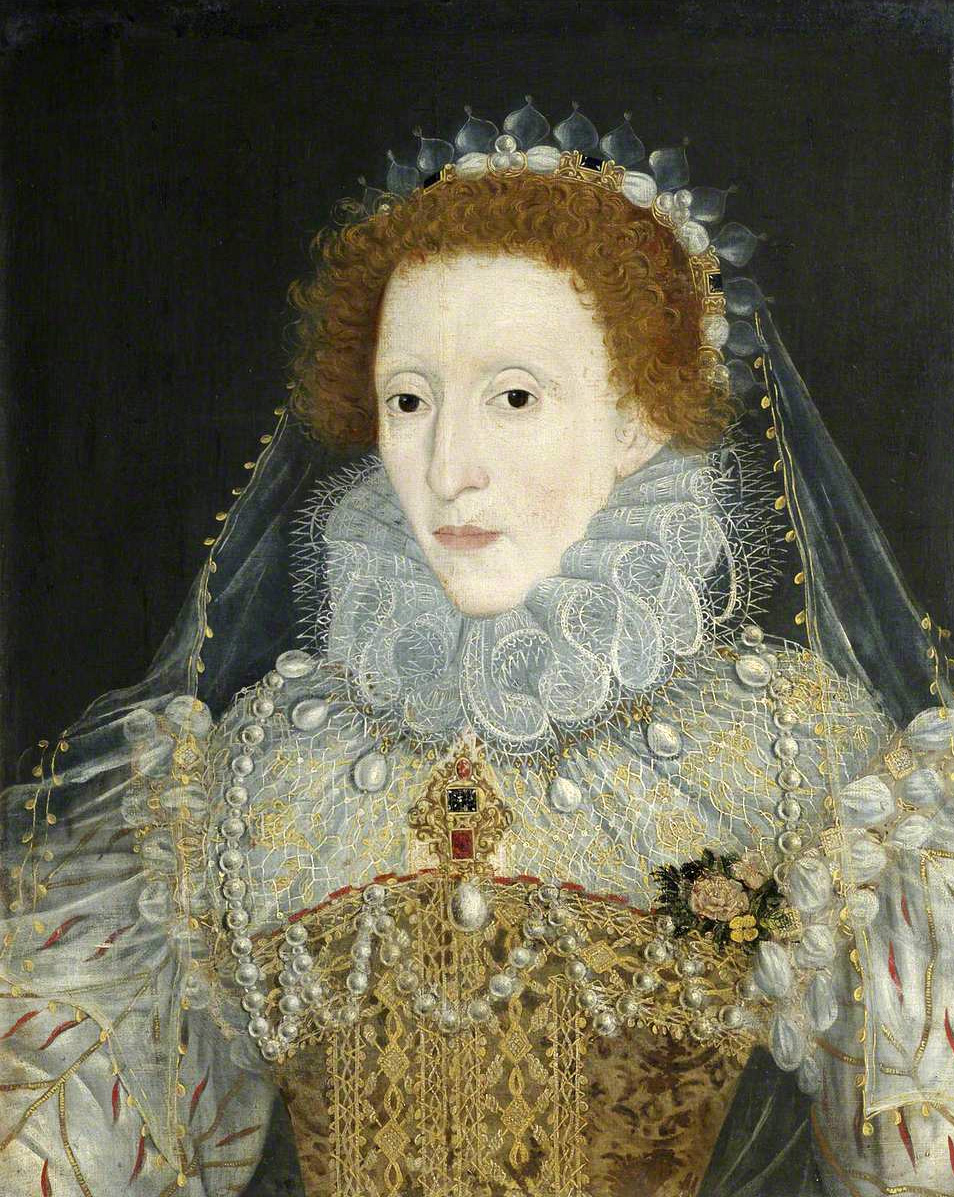
while in this portrait of Queen Elizabeth I of England, her blouse of a different pattern of Mezza Mandolina is not embroiderered (click on the photo for a closer look):


Interestingly, I have been told of a different technique which was also called Mezza Mandolina, done while weaving traditional Buratto fabric in Tuscany. As soon as I have some information on that, I will post it.

I hope this clears up some of the confusion regarding Mezza Mandolina. Please leave a comment below if I haven't answered all of your questions.

Have a look at this website for the author's adventures in recreating Mezza Mandolina. If you want to try it out, here are some tutorials. Or go here for Enza Termini's adventures in recreating Mezza Mandolina in Italian (click on the heading: Mezza Mandolina).

Monday, November 15, 2010

Sardinian Filet Lace - Up Close

I got an exciting package yesterday which I will be dividing up and showing you over the next few days. I do apologize for the long silences of late, I am having a terrible time with my computer. Time for upgrading and it's never smooth. I think that I have most of the kinks worked out but there are still a few things I need to fix up.

One of the things in my lovely package which I got yesterday (kindly carried home from Italy by a lady here in my home town who I do so appreciate!) is an exquisite Sardinian Filet Lace piece:


Isn't it fantastic?
I absolutely love it!
It is flawlessly stitched on hand-knotted netting by a lady in Sardinia. Check out her blog for more examples of the amazing work she and other members of her stitching group do.

Since I have this piece here in my hands, I can take close up shots, scans, look at the back - you name it!! I can't tell you how happy this makes me!

Here is a close up of one of the flower motifs:


... and a peacock:


I had the hardest time figuring out which was the back of this work, there are minuscule knots where she has joined her threads and she has hidden her thread ends expertly!

I have learned so much just by sitting with this in my hands and tracing the paths of the stitching lines. It makes me itch to get back to a piece I mounted on a frame and started almost five years ago.

Thursday, October 14, 2010

Italian Needlework at the Textile Museum of Canada

Some days ago I read of the Textile Museum of Canada's online collection at the Needleprint Blog. I went right away and put "Italy" into the search engine and was delighted to get four pages of results with a total of 46 pieces to look at.

If you're going to look at these or other images on the website, I noticed some things (indicated in red boxes).

Sometimes there was some info on the piece:


And often there were alternate details views and "zoomify views":


Of the "Zoomify" views, I found the second one was always closer (click on the image or use the magnifying glass tool):


There are many different types of pieces to look at from needle lace and bobbin lace, whitework, threadpainting, goldwork, hand-weaving from Perugia, brocades and velvets, Assisi work and some particularly intriguing pieces - I'll give you the catalogue numbers in case my links get broken:

An Altar Cloth with a needle lace edging - Aemilia Ars work? Catalogue no. T96.0239

A Fragment - make sure to zoom in - the description says: Linen toile but I can see knots at the framework intersections and it's basted to gros grain like you would do for Filet work - I've never seen netting this big before or this kind of work done on it. Catalogue no. T95.0203

A Lace Edging - of all of them, I think this one is my favourite, a great piece of Venetian Gros Point. Catalogue no. T03.8.2

A "Shawl" (to me it's a table runner) with typical Antique Deruta work patterns but it's not pulled like the work I've seen, but rather filled in with what looks like Linen Stitch - don't miss the fuserole beads on the corner tassels! Catalogue no. T04.13.3

A Waistcoat - you must zoom in! Catalogue no. T93.0104

I'm off to see what putting "lace" in the search engine will get me...

Monday, September 27, 2010

Circular Filet Lace from Sicily

Yesterday I received a delightful email from a Sicilian lady who wanted to compliment me on my blog. She told me that she had recently started her own website about a needlework technique that she fell in love with about six years ago and taught herself how to do: Circular Filet Lace.

To me, making regular Filet netting looks difficult, but I understand that making Circular Filet netting is even more challenging! Of course I had to go and have a look at her website right away!

Il Filet in tondo [Circular Filet Lace] is full of excellent photos of lovely Circular Filet work and there is even a tutorial with step-by-step photos! As the site is in Italian, I'll tell you a little about the lady who runs it (I'm translating from her biography):

Enza Termine
is a mother of three who lives near Palermo on the island of Sicily at the very southern part of Italy. She tells of being struck by the beauty of pieces of Circular Filet Lace resting on a fig tree outside of the Cathedral of Lipari, one of the largest islands to the north of Sicily. She approached the two elderly people selling the lace and asked who had made it. To her great surprise, she discovered that it was the husband, a retired fisherman, who had produced the pieces. She bought the piece that is pictured on her biography page from them.

After that she searched for information on what she discovered was an art form on the verge of dying out. With the help of a friend she learned how to make filet netting and after much searching and the aid of an old Mani di Fata booklet, she was able to achieve the Circular Filet netting called "Rete a Rosoni" [rose netting, rose intending the big rose windows in cathedrals].

Click on her gallery page to view all of her amazingly beautiful works and don't forget to click on the little flower next to "I lavori delle amiche e non solo" [the works of friends and more] to see work by her friends and at the top of that page don't miss "altri lavori" [other works] and "Natale" [Christmas] for some exquisite Christmas decorations. There are more photos under the "Eventi" [events] page and even more under "Novità" [news]. On the "Novità" page there are the works of a Sardinian lady in her 90s.

If you can't get enough of Enza's work, there are more pictures here.

Thank you Enza for telling me about your beautiful work!

Thursday, July 1, 2010

Alessandro Allori

Sometimes the best way to see examples of Italian needlework is to look at paintings and portraits. I like Alessandro Allori's paintings for exactly this reason. In much of his work you can find examples of lace and embroidery on the clothing and furnishings of his subjects.


Alessandro Allori (1535-1607) was the foster son and student of the artist Bronzino, (whose work is also rich in needlework and textile details).


Until quite recently, images of Allori's works were hard to find, now if you do a Google search however, you can get lost among his meticulous detail for quite awhile.

A detail of Annunciation:


I recently purchased the book: Around the David, The Great Art of Michelangelo's Century, 2003 in which Marina Carmignani has written a chapter on lace and embroidery details in Allori's paintings with particular attention to the works preserved (and recently restored) in the Galleria dell'Accademia museum in Florence which also hosts the David by Michelangelo.


As I was there last year and delighted in the details of Allori's paintings, I have been searching for books on his art that are affordable. This is an excellent book and the chapter preceding the one on lace and embroidery details addresses the "domestic naturalness" of Allori bringing into focus little details like the food and furnishings around the subjects. There is also a chapter addressing the many flowers which are scattered throughout Allori's work and their symbolic meanings.

I really liked this Filet border depicted on this cushion in Allori's work: Madonna and Child with Saints...


...so much so that I think I'll use it on a towel border, you can too, if you like, I charted it:


Allori's works (and others) at the Galleria dell'Accademia in Florence were restored for the 500th anniversary of the David by Michelangelo.


Please note that not all of the paintings here are on display at the Galleria in Florence.

Friday, June 18, 2010

Filet Lace in Turin

Whenever I used to think of Filet lace, I always thought of designs done mostly in Darning stitch or Crochet Filet... Italian Filet from the various regions has really opened my eyes to how different and interesting this ancient art can be.

Right now at the Palazzo Madama in Turin there is a lace exhibit which will be there until the end of the year. This particular display, which consists of 95 pieces of lace including Reticello, Venice Gros Point, Punto in Aria, Filet and types of 17th and 18th century laces, shows the course lace has taken through history. The museum holds over 450 pieces so this is but a small sampling.

If you download their newsletter (at the bottom of the page, click on: SCARICA IL NUMERO O (2MB) - text in Italian), check out the header on top of page 5 for some really unusual needlework with gold and little pieces of coloured stones dating back to the Renaissance which was donated to the museum by Elisa Ricci, foremost Italian needlework scholar, author, collector of the early 20th century. There is a photo of the full piece on the link for the exhibition but it's difficult to see anything, the shot in the newsletter is a closeup of a small section and the gold threads and beads are clearer. There is a full page colour photo of this piece in the book: Tessuti Ricami e Merletti in Italia by Marina Carmignani if you can get your hands on a copy (it's a very expensive book!) though, the text does not go into much detail. This piece alone would be worth going to this exhibit.

Visit the museum's Flickr group to see more than six hundred photos of the museum and some of its displays. It's definitely worth making yourself a cuppa and looking through them, not so much from a textile standpoint but for internal shots of the amazing palazzo! There are more interior photos on the website here.

Ah... where was I? It is so easy for me to get sidetracked... yes, Filet lace. A kind Italian friend sent me some photos of the show - among which were these two photos of a most interesting piece of Filet lace:


Look at all the different stitches used on this piece... and different weights of thread to add emphasis to certain motifs. Definitely a piece worth studying - what a lot of work!

For more reading on a different type of Italian Filet, check out the post on Sardinian Bosa Filet lace. For lots of photos, go to the Museo del Merletto an online museum of lace.

Thanks to Silvia for the photos!