Showing posts with label Online Digital Archive of Documents on Weaving and related topics. Show all posts

Saturday, August 14, 2010

La Sirena - The Siren

Besides monsters, I love finding Mermaids and/or Sirens in embroidery and lace. I can't tell you why and you could even say that the Siren is a type of sea monster.

From Giovanni Ostaus' La Vera Perfezione del Disegno per Punti e Ricami (1561):


They are always wicked in the old tales and it was probably not until Hans Christian Andersen that there was a sympathetic tale of these creatures - don't quote me, I'm not up on my Mermaid/Siren history. The Greeks didn't even associate them with the sea but the Romans did and since we're talking about Italy, let's go with the Romans! You do need to know however that Sirens get some bird-like history from the Greeks so sometimes they are depicted with wings. Enough background – on to the Sirens in needlework!

From Cesare Vecellio's Corona delle nobili e virtuose donne (1592):


Years ago when searching for Italian patterns, I came across the Coraggio Sampler by The Scarlet Letter. This sampler has all kinds of things I like including monsters and a Mermaid. I actually came across a sampler in an Italian museum with the Mermaid from this sampler on it but I didn't note it down and now I'd love to know where I saw it!! Anyone know? Please leave me a comment below!

I like the documentation that goes with the Coraggio Sampler, it has references to 16th century antique pattern books. I ordered it with all the silk threads and then decided to modify it with other antique Italian motifs I liked so it sits on the floor stand in my living room and once in awhile I sit and put in a few stitches on it. I'm afraid it has been sitting there for years.

There are several needle lace Sirens in Merletti e Ricami della Aemilia Ars (1929) including several on a round table centre on the cover which was a piece commissioned "from America", I tried to scan it but unfortunately I can't get a good scan, you'll have to take my word for it...

... there is also this Heraldic design by Arcangelo Passerotti from his Libro di Lavorieri (1591):


In the same book there is this one done in Filet lace for a tablecloth, the design is from Giovanandrea Vavassore's Esemplario di Lavori (c. 1530):


I have always liked the Siren in Elisa Ricci's Old Italian Lace (1913):


I took a crack a charting the design, what do you think? She's pretty scary!


You can download some of Elisa Ricci's books and some antique pattern books from the Online Digital Archive of Documents, or you can purchase a collection of 5 antique pattern books together in one volume from Italian Needlecrafts.

Monday, August 2, 2010

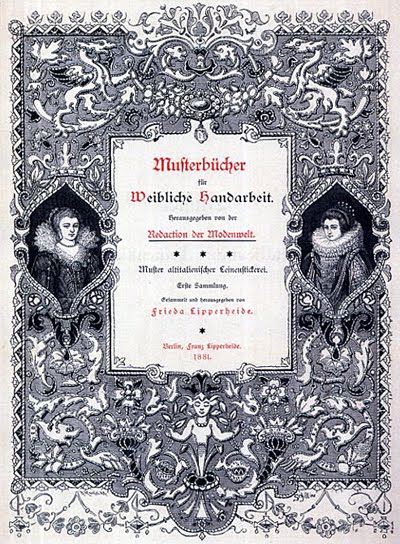
Frieda Lipperheide and Italian Needlework

When I first started collecting printed matter on Italian needlework, of course I looked for material in my own mother tongue. One of the more interesting things I found was Old Italian Patterns for Linen Embroidery by Frieda Lipperheide, (Muster altitalienischer Leinenstickerei in German) translated into English and edited in 1996 by Kathleen Epstein, Curious Works Press.

This is an attractive publication. I can't really call it a book because it is more a collection of folios inserted into a cardboard casing tied together with a ribbon. Very much like the 1897 edition of another publication on German needlework by Frieda Lipperheide that I have. Here we are, 14 years after Ms. Epstein's publication and this volume is difficult but not impossible to find. The Scarlet Letter seems to have it in stock.

Ms. Epstein's text is translated from an 1892 edition. I find it interesting because it has all kinds of patterns for counted thread embroidery with references to pieces which were either in Ms. Lipperheide's (extensive!) collection of from the collections of museums in Hamburg, Berlin, Dresden and Vienna. Also cited are paintings by Da Vinci, Ghirlandaio, Allori, Raphael, Titian and Bronzino.

Ms. Lipperheide believed that Italian embroidery types and patterns descended from Arab influence and many Moroccan stitches and patterns are covered. Her stitch diagrams are good and she often shows the backside. She mentions pattern books by known authors from the 16th century like Mat(t)eo Pagano, Federico Vinciolo and Cesare Vecellio but also one I don't know: Vittorio Serena. There is a good list here of antique pattern books but I don't see him.

I have a copy of an 1881 edition of the text...


... which, since I don't speak any German is interesting for the abundance of pictures and diagrams it has... there seem to be many more than there were in Ms. Epstein's later 1892 edition.

I took a look on the World Catalogue website to see just how many editions of this particular title there were (three - 1881, 1883 and 1892) and was amazed at just how much Ms. Lipperheide had produced. Who was this woman? Someone like me – researching the needlework of Italy from afar? I cannot find anything written about her in English though there seems to have been a book written about her in German in 1999 by Adelheid Rasche called: Frieda Lipperheide 1840-1896: ein Leben für Tetilkunst und Mode [a life of textiles and fashion? I'm guessing here with the help of Google translator.] I'm sorry it hasn't been translated into English or Italian.

Can anyone tell me anything about her?

P.S. Many antique pattern books can be downloaded from the On-line Digital Archive of Documents.

Wednesday, June 23, 2010

Different Styles of Reticello - Part Four

So let's look at those hugely ornate Reticello collars and cuffs of the late 16th and early 17th centuries.

For those of you who may be joining us just now, we started this series on the Different Styles of Reticello here.

As Elisa Ricci says in her introduction to the 1909 reprint of Federico Vinciolo's Les Singuliers et Nouveaux Pourtraicts, "To judge by the number of times this little book by Vinciolo was reprinted between 1587 and 1658, one must believe that the refined and demanding ladies of the time considered it the best of its kind. There are some 17 editions that we know of – but there is reason to believe that there were more, since it is inconceivable that some fragment or recollection of every edition has come down to us, considering the manner in which ladies would use, or rather consume, such pattern books, ripping out the pages and distributing them to their embroiderers, as one does today with patterns found in fashion magazines."

It is amazing that we have traces of these pattern books, considering all the factors against their survival like fire, water, mice, wear and tear, mould, mildew – the ones to survive must have been jealously guarded indeed. There are some that still are... jealously guarded that is. Vari Disegni di Merletto by Bartolomeo Danieli and Libro di Lavorieri by Aurelio Passerotti are ones I'd love to see... I don't know if they contain patterns for Reticello or not.

There is quite an informative article in the back of the Italia Invita 2005 Forum Book by Marialuisa Rizzini on the various pattern books of the 16th century that cites some 156 editions which are known. I thought I had a list of them all at one point but I can't find it now, I will keep looking and post it when I find it.

From Les Singuliers et Nouveaux Pourtraicts by Federico Vinciolo:


Ornate collars and cuffs were the thing to be wearing. Here we have a detail of collar and cuff by Scipione Pulzone, late 1500s (click here for the whole picture):


Elisabetta Catanea Parasole Romana, 1616, Teatro delle Nobili et Virtuose Donne – numerous designs for "Reticella", this is only one page:


There were many other antique pattern books to draw from, and the best way to see the embroideries now is to check out portraits from the period.

From Old World Lace by Clara Blum:


From Old Italian Lace by Elisa Ricci:


There is a free downloadable German version of Elisabetta Catanea Parasole Romana's, Teatro delle Nobili et Virtuose Donne, under Parasole: Musterbuch für Stickereien und Spitzen at the Online Digital Archive. While there you can also download Old World Lace by Clara Blum, and Old Italian Lace by Elisa Ricci and even Federico Vinciolo's Les Singuliers et Nouveaux Pourtracits.

To purchase a reprint of five antique pattern books collected in one volume, check out Disegni per Merletti e Ricami.

Different Styles of Reticello - Part One
Different Styles of Reticello - Part Two
Different Styles of Reticello - Part Three

Wednesday, June 16, 2010

Jesurum - A lace tradition in Venice

Michelangelo Jesurum opened his first lace-making workshop in 1870 after learning the art of Pellestrina bobbin lace as part of an effort going on in Venice at the time (1870) to revive the ancient art of lacemaking which had fallen into decline. Adding coloured threads to the laces earned a Grand Prize for Jesurum at the 1878 Universal Exhibition in Paris. There is a small picture of the prize-winning entry on the Jesurum website but there is a great picture of another coloured silk thread piece in the book: Il Merletto Veneziano by Doretta Davanzo Poli (1998). There are lots of other pictures of Jesurum lace in this book, as well as a wealth of photos of all kinds of Venetian lace and info (text in Italian).

By the beginning of the 20th century there were seven Jesurum workshops employing nearly 3000 women and the lace was recognized and sought worldwide.


Jesurum became lacemakers to the Italian Royal family and other nobility throughout Europe. In 1906 Michelangelo Jesurum opened a Lace Museum in his home.

World War I interrupted the workshops and halted the market for lace. Jesurum kept many of its workers employed making military uniforms. Only a marginal increase in business after the war put the company in danger of bankruptcy and closure. In 1939 the Levi Moreno family took over the company but kept the name as it was well-known and respected.


Some pieces from the Levi Moreno family lace collection are on display at the Relais Ca' Maffio situated half way between Venice and Treviso, if you find yourself out that way!

Recently Jesurum is under new ownership and has opened a new store on Calle Larga XXII Marzo, San Marco 2401 - just off Piazza San Marco in Venice where they sell household and yacht linens.


The Online Digital Document Archive has a free, downloadable Jesurum monograph (text in Italian) in which the last paragraph reads: The simplicity of the manual production used in Venetian lace therefore consents the most variety and the most valuable results: a Jesurum lace has the same worth as any work of art and, like a painting could be signed before being offered for the admiration of those who love beautiful things.

There are photos of Jesurum laces in Elisa Ricci's Old Italian Lace (1913), also available from the Online Digital Document Archive.


On YouTube there is an excellent 9 minute documentary on the lace of Pellestrina. Make sure to watch it in 720pHD!

Tuesday, June 15, 2010

Different Styles of Reticello - Part Three

Sometimes there are people or animals in Reticello as is the case in this border, taken from Old Italian Lace (1913) by Elisa Ricci, preserved now at the Victoria & Albert museum.


(As mentioned in the two previous posts in this series, Old Italian Lace can be downloaded in pdf form from the Online Digital Documents website.)

How can you tell this is Reticello and not Punto in Aria or some other needle lace?
Antonio Merli in his 1864 text - Origine ed uso delle Trine a filo di Refe says the following:
"Reticello is made in two ways: the oldest consists of withdrawing ground threads from a part of the fabric and working a design with the needle over top of those [threads] remaining - perfected then by sometimes adding additional threads when the design requires; the other [method] is by building a square or rectangular framework on top of parchment and working it similarly to the preceding method."
So, see those vertical bars? Reticello. Remember though, very often different techniques were combined on one piece. It is not always easy to find one classification for some embroideries.

From the Collezioni Comunali d'Arte Museum in Bologna:


There is something really interesting in discovering and identifying human figures and animals in needlework. I know some people who even collect all the examples they can find. Figures are found in needle lace (and embroideries) especially in the 16th and 17th centuries.

Maria Del Popolo's style of Reticello is different again from the previous ones we've looked at.


She does some of the most amazing Reticello work which she learned from her mother! This is the cover of her third book: Disegni di Reticello Antico which is just for drooling over, there are no didactic instructions inside like there are in her first two publications: Il Reticello Antico and Reticello Antico e Filet. You can see some examples of her work here, here and here.

Next time we'll visit some of those elaborate Reticello collars and cuffs from Renaissance art and antique pattern books.

You can get Maria Del Popolo's books from Tombolo Disegni. Click on "Libri/Books", then "Libri Ricamo", then "Libri Ricamo Italiani" - send an email request to order.

Different Styles of Reticello - Part One
Different Styles of Reticello - Part Two
Different Styles of Reticello - Part Four

Thanks to Elisabetta for the Bologna Reticello photo!

Friday, June 11, 2010

Different Styles of Reticello - Part Two

As mentioned in Part One of this series, Elisa Ricci has an entire chapter dedicated to Reticello in her book Old Italian Lace (1913) which can be downloaded in pdf format from the Online Digital Documents Archive.

Here is a 16th century shirt from the above-mentioned book with Reticello worked into the sleeves and body. Notice how the designs work together to flow along inside the zig-zagged open parts:


And here in the Collezioni Comunali d'Arte museum in Bologna the design works its way across window after window...


In the past there were works with bigger or smaller areas of Reticello and the same goes for the works of today. While you might think that no one takes the time to work elaborate embroideries of Reticello anymore, there are still embroiderers in Italy who dedicate lots of time to this art.

Laura Marzorati, born in Milan but who now lives in Treviso works some beautiful and intricate designs in her Reticello work. She has learned and continues to learn from some of the best maestras in Italy. Every year she takes courses in different techniques of needlework to keep herself "updated". In 2005 she started teaching needlework at the University of the Third Age in Treviso and in 2008 she founded the non-profit needlework association Treviso Ricama where she teaches a long list of embroidery and needle lace techniques.

In 2007 she published her first book called: Guida al Ricamo Reticello e Merletto Veneziano.


While the text is in Italian, the step-by-step photography is totally amazing! I'm not sure if she put each piece into a scanner or had a super-macro lens but there have never been closer, clearer photos before for this kind of work!


Her second book published in 2009: Guida al ricamo Reticello Liberty has even clearer photos (I didn't think it was possible!) and Italian text. Both books cover the basics and then move on to the filling stitches so you're safe to purchase either one to start. These books can be purchased from Tombolo Disegni. Click on "Libri/Books", then "Libri Ricamo", then "Ricamo Italiani". Send an email request.

In the next installment we'll talk about human figures in Reticello and some of the most intricate modern Reticello needlework being made today.

Thanks to Elisabetta for the photos from Bologna!

Wednesday, June 9, 2010

Different Styles of Reticello - Part One

I recently took some books to show a few friends the different styles of Reticello. I find this technique to be one of the most beautiful of Italian needlework so of course, I have all the books I can lay my hands on about it.

This is a technique that I'm sure we will revisit many times here. Elisa Ricci has an entire chapter dedicated to it in her book Old Italian Lace (1913) which can be downloaded in pdf format from the Online Digital Documents Archive. In that book there are many incredible works pictured, some very old. This painting by Jean Clouet circa 1555 shows that Reticello was already perfected and well known outside of Italy (this is a portrait of the Duchess Claude of Lorraine, daughter of Catherine de' Medici) by the mid 16th century:


This unfinished 16th century piece of Reticello shows the various stages of its working:


Here is a beautiful piece from the Collezioni Comunali d'Arte museum in Bologna:


Like all needlework, Reticello has evolved over time. Today, with less and less time dedicated to embroidery, the designs have become simpler and less time-consuming but no less beautiful.

I want to show you two books by Giuliana Buonpadre, an Italian lady from Verona who has a small shop in Via S. Egidio in which she teaches needlework. On her website you can browse her books, clicking on the cover of Vol. 3, Il Reticello will get you a look at what a typical page looks like. Her books come in three languages, Italian, French and English and I like them a lot because she shows you clearly what to do and what the work will look like once it's done.

She does some amazing work. In her second book on Reticello (Volume 5), she has taken it to a new level. She has added colour to what is traditionally a whitework technique. This is a scan of the cover art on the book Fior di Reticello:


Not only has she added colour, she continues the design outside of the grid. I love the style of these designs even if I'm usually a traditionalist. There are many exquisite coloured pieces in this book, but also lots of traditional white ones as well. I believe that you can get Giuliana Buonpadre's books from the Drawn Thread in the US.

Next time we'll talk about books on a more traditional style of Reticello.

Tuesday, May 25, 2010

Sardinian Bosa Filet Lace

The major difference between Sardinian Bosa Filet Lace and the Filet Lace that is common in other countries are the motifs and the heavier use of the Linen Stitch (or Cloth Stitch) and the Double Running Stitch used to outline motifs such as flowers, leaves and vines. Together with the Darning Stitch and Dove's Eyes these stitches make far more interesting Filet Lace, both to admire and to make. Bosa is a small town in the north-western part of Sardinia in Italy.

Historically embroidered on both ancient Buratto woven linen or Modano knotted netting, today Sardinian Bosa Filet Lace is done almost exclusively on the Modano knotted netting.

Two variations on the Linen Stitch, the Darning Stitch, the Dove's Eye Stitch, edge finishing and frame mounting instructions can be found here in Italian but the diagrams are clear. How to execute a flower and some rings can be found here: click on the various circles in the photo, this will take you to a close-up photo of that particular stitch and then to the right click on the word: "qui" which is underlined to go to a series of photos of how to execute that particular stitch.

This is a lovely Bosa Filet border from the Italia Invita Forum 2005 book:


At the Sardinian Digital Library you can download a book called Arte Sarda - there are many photos of Bosa Filet Lace starting with Chapter Four on page 246 of the pdf.

Here is a piece from the Poldi Pezzoli Museum in Milan:


At the Online Digital Archive you can download Peasant Art in Italy (text in English) by Charles Holme - the chapter Women's Crafts (page 73 of the pdf) by Elisa Ricci has some exquisite examples of typical Sardinian Filet motifs. (Make sure you download the right file, it's the second listing under Charles Holme!)

The first section in Elisa Ricci's book Old Italian Lace (downloadable from the Online Digital Archive) has many examples of Sardinian Filet Lace. I love these birds:


Visit Tuttoricamo and under the "Techniques" heading you'll find an article called "Filet and Bosa Filet" which has lots of links to pictures. While you're there you can read about ancient Buratto woven linen under the "Materials" heading. Learn about Elisa Ricci in the "Prominent Characters" section.

Thanks to Stefania for the museum photo!

Thursday, April 8, 2010

Old Books

At some point I decided to start a library and collect all the books I could find on Italian Needlework. This was (and still is) an expensive endeavour as usually I end up paying twice the cover price of the book because the shipping costs from Italy are so high. Long ago I told myself it was worth it and so I stopped being freaked out by costs and learned to treasure my books for the individual delights that they are. Sure I sacrifice, I don't spent a lot on going out to restaurants, etc. so I allow myself the cost of building my library. I try to limit myself to those books I would really like to have but once in awhile I splurge and buy ones that are just great eye candy.

The first old book I bought was one year at Christmas. An original 1925 edition of Elisa Ricci's Ricami Italiani Antichi e Moderni, Le Monnier, Firenze [Italian Embroideries, Ancient and Modern]. This book is outrageously priced at antique book stores in Italy but I happened across a copy being sold from England for about half of what it was usually going for. I don't even remember where I purchased it from but it wasn't through Ebay or any of the big book chains. The bookstore told me that it wasn't in great shape but that it had all it's pages. That was good enough for me. I told myself it was an essential book to research on Italian Needlework and that sooner or later I would have to have it – and I might never find it so "reasonably" priced. Ah! ...the ways we can justify things to ourselves! I worried and sweat for a month waiting for it to arrive. When it did I understood the shipping costs as it weighs 3.5 lbs!


Hardcover, embossed and gilt. I didn't own anything like it. It is kind of worn away around the edges and two pages were folded over. Other than that, it is pristine. Moreover I don't think anyone ever really studied it. The pages are clean on the edges and there were even four pages that hadn't quite been cut apart properly so that they were still attached to the preceding one at the top edge.

And the contents! I had never seen one book with so many different Italian embroidery techniques and though the photographs are all black and white, there are a great many of them. Of course the text is in Italian and so I had to set about researching some embroidery terminology translations but in the end it has and still does given me countless hours of enjoyment.

A few years later an Italian woman who was (still is!) researching the life and work of the author was able to have this text reprinted in a smaller paperback format. She enriched the text with a detailed index and it is the copy that I use most for research now. I still take the original edition out quite often as the pictures are larger – being that the book is much larger – so I can get out a magnifying glass and really study the details.

Oh I was so hooked after that on old books!

Since those days, the internet has opened up many opportunities and it is much easier now to spend my money. I also now know a bit more about what I'm looking for. Now I have to weigh the pros and cons of each purchase... is it out of copyright and available on websites like the Antique Pattern Library or the Digital Archive of Documents on Weaving and Related Topics? How much of the content is text and how much is patterns or pictures? Will I be able to easily find another copy another time? Other things to consider are things like: does it come from a smoke-free environment? Has it been kept in a moldy basement? If these things are important to you, ask the bookseller. I once bought a stitch encyclopedia that had to sit outside in a bag with a carbon filter and a bag of coffee beans for a really long time before I could handle leafing through it.

Best of all old embroidery books give us a window to the past. A different way of life, a slower pace. A time when there was more opportunity to embroider, and more things to be embroidered!

Websites I like to haunt for old Italian needlework books are:
Maremagnum
Abebooks Italy
LibriBooks
MareLibri
Ebay Italy
Please note that most of these website also sell modern books so watch for publication dates!

You can learn more about Elisa Ricci at TuttoRicamo under the headings "History" and "Prominent Characters", you can also read a review of Ricami Italiani Antichi e Moderni in the "Books" section under "Antique Books" (right hand side of the page), click on "comments".

Tuesday, March 30, 2010

Aemilia Ars needle lace from Bologna - Part Two

After stumbling awestruck from viewing the Aemilia Ars needle lace at the Collezioni Comunali d’Arte Museum (see Part One) my two lovely companions took me off to an exhibition of pieces displayed for a limited time by the Association I Merletti di Antonilla Cantelli. This association is composed of past pupils of the maestra Antonilla Cantelli who practice the Aemilia Ars needle lace as it was taught to them in order to keep the art alive. At this exhibition there were pieces made by her pupils but also pieces made by the master herself on loan from her granddaughter. This is actually where I broke down and cried – overwhelmed by the beauty of these laces. I wish I could show you all my pictures but here are just a few of my favourites:

If you ever get the chance to get to Bologna, do not leave the city without experiencing this incredibly beautiful art!

Okay, now for books!

Merletti e Ricami della Aemilia Ars
is hard to find but worth the hunt. This is a reprint of the 1929 publication showcasing the masterpieces of the original Aemilia Ars Society. Text in Italian, tonnes of good black and white photos!

L’Aemilia Ars di Antonilla Cantelli
– A granddaughter's tribute to the maestra, showcasing her designs and laces. Text in Italian, lots of great photos.

Aemilia Ars, Arts & Crafts a Bologna 1898-1903
. Exhibit catalogue full of photos and the history of the original society and more. Text in Italian, difficult to find but well worth it.

Old Italian Lace
, Volume One by Elisa Ricci - downloadable in .pdf format from the Online Digital Archive of Documents on Weaving and related topics. Lots of black and white pictures and some history too!

If you want to try your hand at this lace there are a few technical manuals out.
For florals there is: Fiori - Quaderni di Aemilia Ars - Nuova S1, 2009. The text is in Italian but the book is packed with step by step clear photos.

For geometric designs, there are a couple to choose from here. These texts are in Italian and English with lots of diagrams. There is also an exhibition catalogue with historical info and pictures.

If you've got the May/June 2009 edition of Piecework, there is a small project there.

To learn more about Aemilia Ars needle lace, visit Tuttoricamo (click on the British flag for the English pages, there are articles under both the "History" and "Techniques" headings. While you're there check out "Prominent Characters": Antonilla Cantelli, Virginia Bonfiglioli and Christine Bishop for even more photos and info. Check out the book reviews to help you make a decision!