
 Posts


Just a quick note today about a website with some fantastic patterns for Assisi Embroidery (among many other types!). Worth a look and some time spent exploring!
Check out Jos Hendrik's website Embroidery and Embroider.
Special thanks to Marnie and her Country Fried Stitches blog, without her I would never have discovered this wonderful source of patterns!
Showing posts with label Assisi Embroidery. Show all posts
Showing posts with label Assisi Embroidery. Show all posts
Saturday, April 2, 2011


Saturday, February 26, 2011
Rolled Hem - Corners
Many people have written asking about how to do corners when doing a rolled hem. I have been trying to work up a tutorial for a while but I did about a dozen corners until I got one that was passable to show you - aside from the very first one I tried just to see if I remembered how to do it which of course, I didn't photograph! It is difficult to photograph and stitch at the same time and my daughter doesn't have the slightest inclination to help me out, so you'll have to forgive the photos. I hope they give you a little bit of an idea anyway.
One thing to note before we get started. I received lots of photos of what readers were trying out after following my rolled hem tutorial and I just have to tell you that when you are stitching into the roll, you do not exit out on to the front of the fabric. That is, when you catch a couple of threads of the roll to secure it down, you do so on the back of the work and you enter and exit the rolled fabric without ever coming out on the front.

Okay, so the corners: they are tricky but with a little practice (and some spit) you can do it!

When you get to the corner intersection of your Four-Sided Stitches, go up over a couple of ground threads and this time you do exit out onto the front of the work, catching one ground thread and the roll to secure the hem. This works great if you are stitching tone-on-tone, you'll never see this little stitch. However, if you are stitching with a thread colour that will be visible, go up a little farther so that when you roll the top hem over, your catching stitch will only be visible on the back of the work.
In the case of this hem, I have ten ground threads of fabric to roll. On the already rolled hem, I trim off the last bit of the roll (in this case about 4 threads):

This will make the top roll easier and less bulky but you must be careful that your edge does not unravel. Use a needle to wrap the top roll tightly - spit on your fingers for a better grip! Take your time with this step, if it's not a good roll, it will show.

The little catching stitch will now serve to hold down the roll as you turn the work and start your stitching as previously done when securing the rolled hem - that is, by entering the roll like the first photo here above.

The rolled hem corner works in theory just like a folded hem corner (not mitred), that is, one fold over the other with a little bit snipped off the edge of the hem that will be hidden. The photo above is the backside of the corner after completing the stitching.
This is the view from the front side:

I wish it was a little more even, but as you can see - I need to practice! I will be hiding my corners with tassels as they do in Assisi embroidery.
If anyone has any other tips for making this easier, please post a comment!
Thursday, September 30, 2010
Rolled Hem
The Rolled Hem is called Orlo a Prillo, Prillino or Birello and probably other names in Italian in the different regions of Italy.
It has been a difficult one for me to do. While at the EGA Seminar a few weeks ago, I sat with Signora Derna and watched her execute a Rolled Hem on the Assisi Embroideries that she was making. Fascinated, I watched her again and again. She made it look so effortless... so easy.
I didn't make any notes and couldn't take any photos - she was so fast! I still don't know if I'm doing it like she did. I checked through my books and found at least three different methods for executing the Rolled Hem.
Fundamentally they all begin the same way. With spit. Yes, I said spit. I have had more than one maestra tell me this. If you lick your floss when you thread your needle, you won't be too grossed out, if not, well... you need to get over it. Spit washes out. Water dampening your fingers works eventually, but not nearly as well, and you almost always get your fingers too wet. What helped me get it was using a high count fabric first until I got the hang of it, and then trying a more openweave fabric.
Yesterday a reader asked me to explain how to do the Rolled Hem so I'm going to attempt it here for her and any others who may be interested, please remember that this is only one of many ways to do it.
I'm demonstrating on 38ct Sotema ivory-coloured linen 20L, which is my favourite linen right now. It's a beautiful weight of fabric and very compactly woven.
First, I withdrew one fabric ground thread about 10 ground threads in from the edge of my fabric (make sure your cut is straight!). Then I skipped four ground threads and withdrew another one. This is the setup for doing the Four-Sided Stitch which is usually found in combination with a Rolled Hem on Assisi work. If I had more time, I would do the Four-Sided Stitch first to group my threads into squares over four ground threads.
Working on the back side of the work, I licked the tip of my index finger and thumb on my left hand and taking the edge of the fabric between the two, squeezed and rolled the hem up a little. You don't have to do too much, like only a couple of inches along the edge at a time. My first roll was a little fat, so I just re-rolled it squeezing a little tighter with my fingers and the roll tightened up. This is such beautiful fabric, the edge didn't even start to fray:

Don't start at the very bottom, but a little above and just keep rolling and squeezing until you get some control. The motion of it reminds me of the way an old boyfriend used to roll his cigarettes.
Using a sharp needle (I think the one I'm using is a no. 7, but it can be smaller - it probably should be at least a no. 8 or 9 but it's what I have handy right now) and some n. 50 crochet cotton thread because it was handy, (you can use floss or Pearl cotton n.12 or finer crochet cotton or even sewing thread) I let a couple of inches of the tail of my thread lay in the part that would be rolled up and came out with my needle about two ground threads into my roll. Working from bottom to top in direction, I entered with the needle into the withdrawn thread channel four ground threads up from where I exited in the roll and skipping four ground threads I exited with the needle like so:

My original exit position in the roll should be about level with my exit position in the withdrawn channel. Then going up to where I entered the withdrawn channel, I enter with my needle into the roll, keeping the same distance as before (about two ground threads), the needle goes between the roll and the fabric, that is, you never come out on the front side when entering into the roll.
Okay, I swear that I only came out at a distance of two ground threads into the roll but while trying to position the camera my roll came slightly undone - it's hard to do this and take close-up photos with only two hands! Everything is stitched with the fabric over your index finger.

I'm working directionally along the edge from bottom to top but I thought Signora Derna worked top to bottom and came out already into her roll... that is, without taking a separate step like I'm doing here, but I just don't seem to be able to figure that out right now.
Remember: when going into the roll, you never pierce your ground fabric so that the stitch will be visible from the front. Here is what a little bit of Rolled Hem looks like from the front:

This is how it looks on the back. Click on the photos for a closer look:

And here we have a bit of Four-Sided Stitch beside the Rolled Hem:

Sorry my photos aren't better, my photographer is not home this afternoon and I probably should have used coloured thread! See? I'm learning too!
Does this help at all?
Tuesday, July 27, 2010
Italian Blackwork
In the Victoria & Albert Museum in London there is a 16th century Italian Blackwork sampler. This sampler fascinated American needlework teacher Dakota Rogers so much that she reproduced patterns from it to make an exquisite sampler of her own called Tiramisu.
This is my own stitched Tiramisu, I took the class from Dakota Rogers through the Embroiderers Guild of America in 2008:

La Muta by Raphael depicts some Italian Blackwork, check out the cuffs.
Here we see a late 16th century Italian man's shirt taken from At Home in Renaissance Italy, 2006:

In the Palazzo Davanzati in Florence there is a 17th century Italian sampler with Blackwork on it:

Elisa Ricci in her Ricami Italiani Antichi e Moderni, 1925 notes that Punto Scritto (Backstitch) in Italy is most often found in combination with some other embroidery technique like Satin Stitching or Cross Stitching such as the fretwork in Assisi Embroidery:

Lucia Petrali Castaldi in her Dizionario Enciclopedico di Lavori Femminili, 1941 lists Punto Scritto being interchangeable with Punto Volterrano [Volterra Stitch]. There are no examples pictured and no other information.
In the introduction of the 2007 book Volterrano 2006 by Antoinetta Monzo Menossi, Rosalba Niccoli talks about the difficulty she experienced in finding any trace of Punto Volterrano in Volterra, Italy. It seems there were two kinds of embroidery: the oldest being "il punto scritto volterra" [Volterra Backstitch], said to have been executed in gold thread though no proof or extant samples survive; and "il punto volterrano" [Volterra Stitch] created by a teacher named Emma Gazzarri from the Technical Institute in the mid 1900s. Antoinetta Monzo Menossi took all this information into account when creating patterns for the small volume of delightful designs (text in Italian).

Other Italian books on Blackwork are: Poesia di uno stile: Interpretazione Liberty by Manuela Alida D'Anna, 2009 (text in Italian, English and German) charming designs in Art Nouveau style with excellent technical execution instructions; L'Arte del Blackwork, 2007 and Idee in Blackwork, 2009 by Bruna Scagnetti & Gabriella Antoniazzi (text in Italian and English) of the association Il Friuli Ricama.
All books listed are available from Tombolo Disegni. Click on: Libri/Books, then Libri Ricamo, then Ricamo Italiani or Blackwork (different books are listed on different pages) – send an email request to order.
Thanks to Armida for the Palazzo Davanzati sampler photo!
Sunday, July 25, 2010
Monsters
I don't know why, but I really like monsters in needlework. I look for them and delight in finding them often in Italian needlework.
From the cover of Il Lavoro a Fuselli by Amelia Brizzi Ramazzotti, 1917 (Bobbin Lace):

From the cover of Punto D'Assisi by Adele Della Porta, 1916:

Assisi embroidery patterns are full of monsters!
Here are some for Cutwork from Cucirini Cantoni Coats' Ricami ad Intaglio:

There are often monsters in antique Italian Filet work:


Above images from Elisa Ricci's Old Italian Lace, 1913.
Here are some Whitework monsters from Emporium, Vol. XLIII, Arte femminile all' "Umanitaria", Alfredo Melani 1916:

Even in old stamps for textiles as in this pear wood hand-carved stamp from the first part of the 20th century, part of a collection owned by Arnaldo Caprai:

I could go on and on (and probably will at some later date) but what I originally wanted to tell you about was Elena Rossi's new digital pattern book: Patterns of Mythical Creatures from Tuscan Churches.

In her travels, Elena photographed strange monsters from the façades San Michele in Lucca and San Damiano al Monte in Florence and then has created designs for embroidery or other crafts from them. In the book each pattern is accompanied by a picture of the façade that it comes from. Every pattern is presented facing both right and left for ease of reproduction.
10 different monsters means that you could do a monster sampler!
From the cover of Il Lavoro a Fuselli by Amelia Brizzi Ramazzotti, 1917 (Bobbin Lace):

From the cover of Punto D'Assisi by Adele Della Porta, 1916:

Assisi embroidery patterns are full of monsters!
Here are some for Cutwork from Cucirini Cantoni Coats' Ricami ad Intaglio:

There are often monsters in antique Italian Filet work:


Above images from Elisa Ricci's Old Italian Lace, 1913.
Here are some Whitework monsters from Emporium, Vol. XLIII, Arte femminile all' "Umanitaria", Alfredo Melani 1916:

Even in old stamps for textiles as in this pear wood hand-carved stamp from the first part of the 20th century, part of a collection owned by Arnaldo Caprai:

I could go on and on (and probably will at some later date) but what I originally wanted to tell you about was Elena Rossi's new digital pattern book: Patterns of Mythical Creatures from Tuscan Churches.
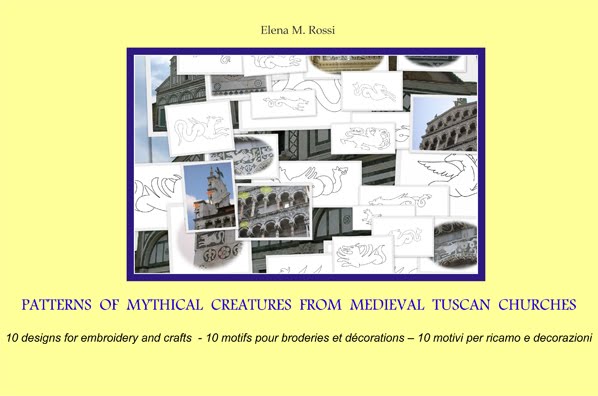
In her travels, Elena photographed strange monsters from the façades San Michele in Lucca and San Damiano al Monte in Florence and then has created designs for embroidery or other crafts from them. In the book each pattern is accompanied by a picture of the façade that it comes from. Every pattern is presented facing both right and left for ease of reproduction.
10 different monsters means that you could do a monster sampler!
Wednesday, June 2, 2010
A shop in Assisi
I don't think I ever would have found it on my own... Arte Nostra in Via S. Agnese no. 8, Assisi. It's quite a big shop with lots of finished embroideries in the window and all over the shop displayed very attractively. Vima deMarchi Micheli took us there on the day we visited Assisi, Italy on her Italia Mia tour last year.

There were Assisi Embroideries and Catherine de'Medici Embroideries and other works of classic embroidery techniques for sale. Lots of lovely table runners, towels, cushions, tablecloths and dozens of other beautiful things.
Monica Manichini the owner showed us how to execute the main stitch in Catherine de'Medici Embroidery, the Double Running Stitch, done in such a way as to make the line of stitching look like a twisted thread sitting on top of the fabric.

While there, in addition to a small placemat in Catherine de'Medici Embroidery, I also bought the two books I talked about on Assisi Embroidery and Catherine de'Medici Embroidery in this post by the Accademia Punto Assisi. I don't know how else you can get these books other than contacting the store or the Accademia, I'm not sure if they are commercially sold anywhere else.
Unfortunately I must have been having a shaky day, as most of the pictures I took were very blurry...

These are some beautiful works of Catherine de'Medici Embroidery, I really liked the peacocks in the bottom left.
If you're in Assisi, don't pass up visiting this shop - it is a true delight.
Wednesday, March 24, 2010
Assisi Embroidery - Part Two
The books I have on Assisi Embroidery vary from just pattern books to ones with historical information on the technique and the area it comes from. I started out with Ricami d'Assisi [Assisi Embroidery] 2 and 3 published by Mani di Fata. I hand-wrote a letter and mailed it to them requesting the two books that I'd seen in an edition of an Italian embroidery magazine, probably RAKAM. (By the way, those of you in the U.S. can order a subscription to RAKAM from Amazon) They wrote me a letter back stating that I could order from them only if I followed a long and complicated list of instructions which required photocopies of the front and back of my credit card, identification, etc. We're talking about 10 years ago or so... when the internet was nowhere near as sophisticated as it is today. I actually faxed my info to them and waited months for my books to arrive. Thankfully life is not like that anymore!
Later I discovered Punto Assisi, Editrice Minerva, 2001. The blurb said it was in Italian and English on whatever website I bought it from, however I was disappointed to find that only the technical directions were translated (there is German and French too!) and the whole history section was not. I know it was recently reprinted (2007) with some updates but I don't know if the history text is now translated or not. If someone out there knows, will you post a comment? The older edition has a blue cover, the newest edition has the same pattern but it is in red. The collection of patterns in this book is quite extensive, from little patterns to big ones, central designs for tablecloths and borders galore – traditional Italian designs with all kinds of strange animals (my favourite!). The bibliography is extensive and helpful to those seeking more information. This book is well worth the trouble of hunting it down.
An interesting book is the Variety Book No. 4, Carmela Testa Co. Inc., 1925. This is all in English with great close-up photos. This book also has quite a lot on hemstitching, showing how to stitch the rolled hem and withdraw threads for open work. If you're lucky enough to find this on Ebay, grab it! Otherwise you can get a restored copy from Iva Rose in the U.S.
My absolute favourite Assisi Book is Il Punto Assisi by Raffaella Bartolucci Cesaretti, 2004. It is a hard cover book loaded with great photos of existing embroideries. The text is in Italian and extensively recounts the history of the technique and those who practiced it over time. Symbology and designs are explained and there are about 10 pages of designs, some very complex! The bibliography is extensive. I wrote to the author directly to get my copy and sent her a money order (back when it first came out) but I have seen it turn up on searches at alibris.com and abebooks.com from time to time.
I have Old Italian Patterns for Linen Embroidery by Frieda Lipperheide originally published in German in 1892, this edition was translated into English by Kathleen Epstein in 1996. This is a lovely collection of patterns. Not really a book but a collection of folios. It is beautifully presented and the folios are easily used when stitching. It has historical information on Italian Embroidery in general and encompasses other techniques besides Assisi Embroidery.
My latest acquisition is just a pattern book but I'll mention it as it is interesting. The patterns are a collection of the last 10 years of research by the Accademia Punto Assisi. They have painstakingly recorded patterns from pieces of embroidery from the trousseaux of local women. The collection is spiral bound with a sturdy cover that folds out so that you can stand the book up on a table top when you're working!
Mad Samplar Books in the U.S. has a great selection of books on Assisi Embroidery.
Assisi Embroidery Part One
Tuesday, March 23, 2010
Assisi Embroidery - Part One
Of all the types of Italian needlework, Assisi Embroidery is probably the most recognized by non-Italians. That is, most embroiderers are at least conscious of it, if they haven't done a bit of it themselves. It is a very attractive counted thread technique that dates back to at least the 13th century, if not before.
There are a number of books on the market, some with traditional designs, some with more modern ones. I have quite a few. In my listing of the books that I have, I didn't list all the strictly pattern books, nor all the electronically scanned out-of-print and out-of copyright ones. I honestly have to stop myself from automatically buying a book on Assisi embroidery every time I come across one that I don't already have!
Almost 10 years ago I bought a yard of 28 ct 'Assisi' Graziano Linen from the US. By the time I factored in the exchange rate between the Canadian and American dollars (the Canadian dollar was not doing as good then as it is now) and the shipping, my yard cost me nearly $200 Canadian dollars. I'm happy to say that it is now easier and much less costly to have this lovely linen. And lovely it truly is! The threads are nice and plump and the fabric is weighty so that it makes great tablecloths, placemats, napkins, centres, doilies, you name it!

I love the combination of the voided work and the fretwork along the borders but most of all I love the hems! Four-Sided Stitch (done on this piece in off-white no. 8 pearl cotton) runs along the hemline (withdraw one or two ground threads for a more open effect) and the edge is finished with a rolled hem. I'm sad to say that I have never quite been able to achieve a rolled hem this small (or this neat!). The trick, I was told, is to wet your fingers with saliva and roll the fabric as you stitch. Here is the back of the same corner, notice how far into the rolled hem the hemstitches go in order to keep the roll in place... almost far enough to be seen from the front.

There are a number of books on the market, some with traditional designs, some with more modern ones. I have quite a few. In my listing of the books that I have, I didn't list all the strictly pattern books, nor all the electronically scanned out-of-print and out-of copyright ones. I honestly have to stop myself from automatically buying a book on Assisi embroidery every time I come across one that I don't already have!
Almost 10 years ago I bought a yard of 28 ct 'Assisi' Graziano Linen from the US. By the time I factored in the exchange rate between the Canadian and American dollars (the Canadian dollar was not doing as good then as it is now) and the shipping, my yard cost me nearly $200 Canadian dollars. I'm happy to say that it is now easier and much less costly to have this lovely linen. And lovely it truly is! The threads are nice and plump and the fabric is weighty so that it makes great tablecloths, placemats, napkins, centres, doilies, you name it!
Traditional Assisi Embroidery is stitched on off-white coloured Assisi linen in either blue or rust coloured embroidery floss. The cross stitch can be regular x's or long-armed cross and the 'x' part should be made over three fabric ground threads. I've made a couple f scans of a piece that was a gift to me, made in Assisi. Outlines of the design are done first in a darker floss, black or dark brown with the Double Running Stitch. The fretwork is also executed in Double Running Stitch.

I love the combination of the voided work and the fretwork along the borders but most of all I love the hems! Four-Sided Stitch (done on this piece in off-white no. 8 pearl cotton) runs along the hemline (withdraw one or two ground threads for a more open effect) and the edge is finished with a rolled hem. I'm sad to say that I have never quite been able to achieve a rolled hem this small (or this neat!). The trick, I was told, is to wet your fingers with saliva and roll the fabric as you stitch. Here is the back of the same corner, notice how far into the rolled hem the hemstitches go in order to keep the roll in place... almost far enough to be seen from the front.

Of course I also love the tassels! Traditionally in groups of three, these tassels are made of no. 8 pearl cotton thread. The Anchor Manual of Needlework, which has quite an extensive section on Italian Needlework, has instructions on how to make these great little tassels.
You can read more on Assisi Embroidery at the Italian needlework website TuttoRicamo, click on the British Flag for the English pages and look under 'Techniques'. While you're there, you can download an old book on Assisi Embroidery from the early 20th century in .pdf format. Click on the first link under the 'Books' heading in the Assisi article, this will take you to another page. Under the first heading of 'Adele della Porta' you'll see the link. There are some great fantastical beasts in that book.
Here you can find 28ct Assisi linen made by another great Italian linen manufacturer, Sotema as well as many great Assisi pattern books by Mani di Fata
Tomorrow I'll tell you about some of the books I have on Assisi Embroidery that aren't strictly patterns only...
Assisi Embroidery Part Two
Subscribe to:
Posts (Atom)

