Showing posts with label bobbin lace. Show all posts

Sunday, July 27, 2014

St. Bridget's Altar Cloth


Almost a year ago I was contacted by a lady from Sweden who is the grand-daughter of a lady named Elsa Peterson who started a lacemaking company in Vadstena in 1920. Today the company is run by the lady who contacted me's 90-year-old mother and she was interested in reproducing some old patterns so that they would not be lost.

Now, there was a highly skilled designer/lacemaker named Aurore Ingelotz who lived in Vadstena from 1889 to 1893. She specialized in making designs for the church. In 1895 she made and sent a lace altar cloth to Santa Brigida Church in Rome. Now St. Bridget of Sweden came from Vadstena so you can begin to see the connection. (Aurore's work was so good, some of it was selected to represent Sweden at the 1893 Chicago World Exposition.)

Well, back to our story. Some of Aurore Ingelotz's patterns were recovered from an attic and found their way into Elsa Peterson's possession. Here you can read (with the aid of Google Translator if you don't speak Swedish) the fascinating story of the research behind these patterns done by the lady who contacted me.

While doing her research, this lady was trying to find out if the lace altar cloth sent to Rome in 1895 still existed. We contacted Santa Brigida Church to find out that yes, it was still there and was used and exhibited once a year during the celebrations of the canonization of St. Bridget on October 7.

As I was going to be in Rome at the time, I offered to try to see if I could get some photos of the altar cloth or at the very least, go to see it for myself. The sisters of Santa Brigida also took some pictures in the meantime and when we visited they were very kind to let my friend and I have a few minutes after the ceremony alone at the altar to take a few photos.


The altar cloth is 4.4 meters long and 1.3 meters wide, at each end there is a medallion (two different designs) and there is a lace border of 20 cm wide.


Thank you very much Karin for letting us share in your adventure!

Saturday, May 17, 2014

Venetian Needle Lace - new book


Of all the needle laces, those from Venice and Burano are certainly the most complex, but they are also the most versatile because the limitations imposed by the design are removed.

This publication contains a how-to section of the stitches to start you off accompanied by instructions, photographs and very clear diagrams.


Exciting news for those who wish to delve into the world of Venetian Needle Lace! Ombretta Panese and Marialuisa Severi have been hard at work creating this book. 

I have translated what Ombretta has written on her blog:

We have tried to give clear and simple instructions on some stitches, which are supported by photographs and designs, so as to introduce the manufacture of needle lace to those who have the intention to learn.
At the end we have included designs of varying degrees of difficulty so you can experiment with what you have learned.


About the authors:
Marialuisa Severi is the President of the cultural Associazione "Il Merletto Veneziano" which was formed in 2005 with the aim to keep alive, enhance and promote the ancient art of Burano needle lace and Pellestrina bobbin lace. Both techniques are traditionally rooted in the island territory of Venice. You can see some pictures of their work here.

Ombretta Panese is a lacemaker from Mestre who has been awarded the title: Expert Needle Lace Maker achieved after two courses of 300 hours each, at the Scuola Professionale della Provincia di Venezia. Together with some of her classmates from these courses, she was involved in the creation of the Associazione "Il Merletto Veneziano". She does some beautiful work, check out her blog.

My copy is in the mail somewhere between here and Italy but I couldn't wait for it to get here before telling you about this book which you can get directly from the publisher: NuovaS1 (send them an email and tell them you'd like to use PayPal for those outside of Europe). Lacis distributes some NuovaS1 books in the US, if you want to see this one brought in, you may have to write to them and request it.

Let me know what you think in the comments below if you do get this book which I understand may be the first in a series.


Thursday, December 26, 2013

Needlework in Martina Franca, Puglia


In Martina Franca, Puglia while I was picking up some handmade pasta and local cheese to take to a friend in Ferrara I asked the shop owner if there were any handmade embroidery or lace shops in town. She told me that there was one shop with things of the 'certain quality' that I was looking for in the main square.


Simply called: Pizzi e Merletti di Nella Acquaviva [Nella Acquaviva's Laces] the shop indeed sits opposite the big fountain in Piazza Roma, no. 17. We had missed it on our way through the square because it wasn't open yet and the sign is on the inside of the big brown wooden door which covers the window when the shop is closed. We arrived breathless with excitement to find the owner of the little shop, Signora Acquaviva among a treasure trove of needlework.

Signora Acquaviva's specialty is hand-knotted netting Filet embroidery and she showed us a few sets of guest towels and curtains that she had made herself, including one towel set of pale blue linen with the most amazing padded embroidery done on ivory-coloured hand-knotted netting - it was a masterpiece!

There were also many sets of Tatted earrings done with various semi-precious stones, crystals and pearls including a lovely set with cameos made in Naples!


We discovered some exquisite Tatted sachets and Filet lace inserts which we really couldn't help ooohing and ahhhing over. The work was so fine and all done by the Signora herself.

In the shop window display was a particularly fine piece of bobbin lace done in the technique called Rosaline:

Rosaline bobbin lace in front with Filet lace on the table.
Signora Acquaviva does work on commission as well and showed us some lovely wedding favours and a breathtaking large oval Filet Lace insert ready to be attached to a floor-to-ceiling-sized curtain. If you find yourself in Martina Franca, do not miss this shop!

A huge thank you to Susan for the photos!

Tuesday, February 19, 2013

Lace Collection - Genoa


Jewels of Thread is the English translation for the title of the catalogue for the laces in the Genoese public collections.


This catalogue of the first of a planned series of exhibitions of almost the entire lace collections of the Civiche Collezioni Tessili [Civic Textile Collections] and the Collezione Tessile della Soprintendenza al Patrimonio Storico Artistico della Liguria [Textile Collection of the Department of Historic Artistic Heritage of Liguria].

Written in Italian, it has a wealth of information regarding the laces in the collections (which number about 300 pieces dating between the 16th and 20th centuries) but also the history of lace in Genoa, mechanical laces, commercial production in Genoa, a glossary and of course a rich bibliography to investigate if you want more information on Genoa and lace.

In this volume, Maria Daniela Lunghi and Loredana Pessa have shared some of the wealth of their knowledge on these subjects and have offered detailed particulars on the lace pieces in the collections. This is a valuable resource also for the names and dates of contributors and collectors, if you have been trying to access information relative to this area of study, this catalogue is a gold mine of information.

Needle lace pieces include borders and inserts, tablecloths, collars, sleeves, scarves, frills, handkerchiefs, doilies, furniture coverings, bonnets, baby shoes, some religious articles and a bolero.

Bobbin lace pieces include borders and inserts, cuffs, collars, shawls, ties, sleeves, head coverings, furniture coverings, handkerchiefs, bibs, veils, fans, doilies, parasol covers, a sleeveless jacket and a bed spread.

There is a large assortment of items of a wide variety of mechanical laces (including whole dresses!) and also quite a lot of Macramè, crochet lace and metallic bobbin laces.

These collections are held at the Palazzo Bianco by the DVJ (Damask, Velvet, Jeans - Textile Fashion Museum) in Genoa.

Thanks to M. Daniela Lunghi for sharing this with us!


Sunday, December 16, 2012

Genoese Needlework, Textiles and Fashion - Part One


I know almost nothing about Genoa, Italy in relation to textiles. I've never been there and so it is conspicuously missing from the range of needlework that I've talked about here.

I was recently contacted by Maria Daniela Lunghi, a fibre artist, author and textile history specialist from Camogli in the province of Genoa. She was kind enough to send me some textile museum catalogues from Genoa.


I colori del lusso. Scialli del Kashmir a Genova [The colours of luxury. Kashmir Shawls in Genoa] is a little booklet of 32 pages with lots of lovely colour photos of the collection of Kashmir shawls displayed at the exhibition in 2002 at the Museo di Sant'Agostino in Genoa. It covers the history of textiles in India, the production of cashmere in europe, woven shawls and printed shawls among a few other interesting things. (Text in Italian.)

Now, you might be thinking: What do cashmere shawls have to do with Italy? Well, you may or may not know that Europeans had some periods of time where Eastern designs, fabrics and customs became very fashionable. Periods of Turkish, Chinese, Japanese, Bedouin as well as other eastern styles each had their turn influencing the latest fashions for European women and men and India had her turn as well.

Marchesa Emilia Negrone Centurioni by Giuseppe Antonio Frascheri. Oil on canvas. Villa Saluzzo Serra di Nervi, Galleria d'Arte Moderna, Genoa.

This little catalogue also discusses the influence of these shawls on the fashion pages of French magazines, the commerce of Kashmir shawls in Genoa and the relationship between Genoese men and women and Kashmir shawls.

There is a small bit at the end about the restoration and conservation of this collection.

I learned quite a bit about these shawls and their high appreciation by Italian women of the period between 1770 and 1870.

Thank you M. Daniela Lunghi for this fascinating lesson in fashion!

Tuesday, December 7, 2010

Passementarie - The Milan Stitch

The history of Passementarie is hard to follow. The term itself can mean so many different things: braids, cording, ribbons, tassels, gimp, fringe and more. There is evidence of Passementarie in ancient Egyptian tomb paintings and in ancient Chinese, Japanese and Roman legends as well.

Some historians think that elaborate braided Passementarie were the beginnings of Bobbin Lace. Most European countries have history of a different era where both clothing and interior decorating were embellished with Passementarie according to the fashion of the time and place.

In old texts, you'll find it under different names: Passaments (English), Passamani (Italian) stemming from the French term Passementarie which is widely used today.

During the Middle Ages and beyond in Europe, there were guilds for Passementarie shops and it was considered an art form (as is the handmade Passementarie of today) requiring years of apprenticeship. Long trims were executed on pillows (like lacemaking) or with complex hand-operated machinery. To see many technical illustrations from Diderot & d'Alembert's Encyclopedia (18th century) regarding Passementarie, click here.

In a previous post I told you about a Passementarie shop that I went into in Florence, where they make a lot of what they sell by hand. Here are only a couple of tassels that I got there.

I use this one as a scissor fob:


And this one for my clothes dresser handle:


Not the best photos, I seem to be very shaky today, but you get the idea of the intricacy of the work.

There are still many Passementarie shops in Italy and it's fun to check them out as they are full of all manner of trimmings which, if you are fortunate, are handmade and therefore so much more interesting than the coldness of the machine-made stuff. It takes a certain talent with colour and design to make beautiful Passementarie.

While searching for something else, I happened upon a Facebook page which is open for non-Facebook members (I know because I don't belong to Facebook) called Il punto Milano: sapresti farlo? [The Milan Stitch: would you know how to do it?]

For those who don't speak Italian, it says:
"The Milan stitch is a type of needle made braid generally used in passementarie to cover (in silk or cotton) the head of tassels (see photo) but also buttons, accessories and weapons, the name probably comes from here (as the production of competition weapons was one of the principle industries of Milan).
Widely used in the 18th century, counting the numerous [extant] examples from the first half of the following century, it then slowly fell into disuse and we completely lose the technique.
This group is formed with the precise intent of recovering that technique. Anyone who has news or knows enthusiasts and experts in the field of passementarie is asked to put them in contact with this group or me via email.
In the photos are also a few pages of a French book on passementarie in which a similar stitch is shown and explained.
Anyone - an enthusiast of braiding - who would like to try to figure out the technique of the 'Milan Stitch' from those instructions and is successful will have eternal gratitude and a substantial reward.

p.s.

Unidentified sources claim that certain Berber tribes from Morocco cover buttons with a braiding that is similar to the 'Milan Stitch'. Research of this lead is made all the more difficult as these are nomadic tribes. Therefore, on one hand it is difficult to trace them and on the other hand, if you did have such luck [as to find them] you would have to follow them across the desert in order to have them teach you the technique, with all the linguistic and logistic difficulties involved."

Since this post was left on April 16, 2009, no one seems to have helped this group achieve their goal. What do you think? Can anyone help?

Thursday, October 14, 2010

Italian Needlework at the Textile Museum of Canada

Some days ago I read of the Textile Museum of Canada's online collection at the Needleprint Blog. I went right away and put "Italy" into the search engine and was delighted to get four pages of results with a total of 46 pieces to look at.

If you're going to look at these or other images on the website, I noticed some things (indicated in red boxes).

Sometimes there was some info on the piece:


And often there were alternate details views and "zoomify views":


Of the "Zoomify" views, I found the second one was always closer (click on the image or use the magnifying glass tool):


There are many different types of pieces to look at from needle lace and bobbin lace, whitework, threadpainting, goldwork, hand-weaving from Perugia, brocades and velvets, Assisi work and some particularly intriguing pieces - I'll give you the catalogue numbers in case my links get broken:

An Altar Cloth with a needle lace edging - Aemilia Ars work? Catalogue no. T96.0239

A Fragment - make sure to zoom in - the description says: Linen toile but I can see knots at the framework intersections and it's basted to gros grain like you would do for Filet work - I've never seen netting this big before or this kind of work done on it. Catalogue no. T95.0203

A Lace Edging - of all of them, I think this one is my favourite, a great piece of Venetian Gros Point. Catalogue no. T03.8.2

A "Shawl" (to me it's a table runner) with typical Antique Deruta work patterns but it's not pulled like the work I've seen, but rather filled in with what looks like Linen Stitch - don't miss the fuserole beads on the corner tassels! Catalogue no. T04.13.3

A Waistcoat - you must zoom in! Catalogue no. T93.0104

I'm off to see what putting "lace" in the search engine will get me...

Monday, October 4, 2010

Sansepolcro Lace Biennial - Follow up

Just to follow up on my post about this year's Sansepolcro Lace Biennial - please visit Mena's blog: Tombolo e altro for some photos and a run-down of her experiences, there is also a second post with more photos and *gasp!* a MAN doing bobbin lace! The blog is in Italian, so you might need to run it through Google Translate.

There are some photos of the exhibition and a few of the lace masters. Click on the photos for close-ups, don't miss the banner with the Renaissance lady - she has applied lace and leather on her gown! There is a bit more here (in Italian) about the event and the winners.

Canadian lacemaker Lenka Suchanek also took a prize, you can see her piece here.

If anyone knows where there are more photos of this event will you post below?

Sunday, August 22, 2010

Fili di Liguria - Threads of Liguria


This exhibition is going on right now until September 30, 2010 at the Abbey of San Fruttuoso a little to the south of Genoa on the north-western coast of Italy.

Liguria is well-known throughout history for it's textiles, macramé and bobbin lace and there is plenty of all that at this little show.

Two dresses from paintings of Genoese nobilewomen have also been recreated in exacting detail. The gown from this portrait by Rubens of the Marchesa Brigida Doria Spinola (1606) and the gown from this portrait by Van Dyck of Caterina Balbi Durazzo (1624).

On YouTube there is a six-minute video of a television report on the exhibition. It is particularly interesting as they show some great details of the gowns. There are also some beautiful fabrics and macramé fringes as well as laces and gold embroideries. Worth a look!

Sunday, July 25, 2010

Monsters

I don't know why, but I really like monsters in needlework. I look for them and delight in finding them often in Italian needlework.

From the cover of Il Lavoro a Fuselli by Amelia Brizzi Ramazzotti, 1917 (Bobbin Lace):


From the cover of Punto D'Assisi by Adele Della Porta, 1916:


Assisi embroidery patterns are full of monsters!

Here are some for Cutwork from Cucirini Cantoni Coats' Ricami ad Intaglio:


There are often monsters in antique Italian Filet work:


Above images from Elisa Ricci's Old Italian Lace, 1913.

Here are some Whitework monsters from Emporium, Vol. XLIII, Arte femminile all' "Umanitaria", Alfredo Melani 1916:


Even in old stamps for textiles as in this pear wood hand-carved stamp from the first part of the 20th century, part of a collection owned by Arnaldo Caprai:


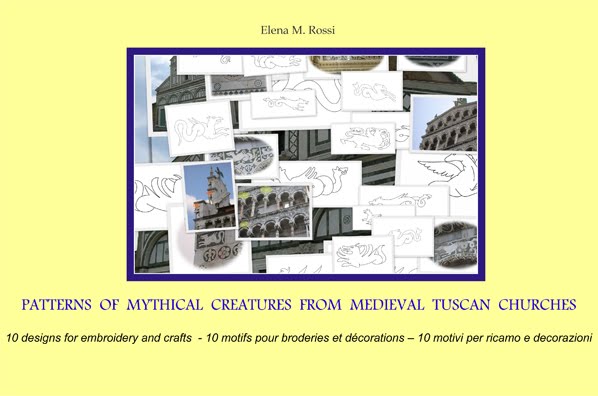
I could go on and on (and probably will at some later date) but what I originally wanted to tell you about was Elena Rossi's new digital pattern book: Patterns of Mythical Creatures from Tuscan Churches.


In her travels, Elena photographed strange monsters from the façades San Michele in Lucca and San Damiano al Monte in Florence and then has created designs for embroidery or other crafts from them. In the book each pattern is accompanied by a picture of the façade that it comes from. Every pattern is presented facing both right and left for ease of reproduction.

10 different monsters means that you could do a monster sampler!

Monday, June 28, 2010

World's Fair – Milan, 1906

"Our exposition, inaugurated the 3rd of May, 1906 by Their Majesties the King and Queen of Italy, was utterly destroyed by the overnight fire of August 2nd and 3rd. The pages of this book, collected while our halls offered themselves to the public like inspired revelations of Italian art and work, today take on a particular documentary merit and are left as a reminder of the artistic work done, the thought and the love of those who promoted and prepared it."
-- Le Industrie Femminili Italiane, 1906


... although rescue was quick, and despite the dedicated efforts of firefighters, both the Italian and Hungarian exhibitions of the Decorative Arts were engulfed in flames. When day came, all that remained of the site was a pile of smoldering rubble and charred beams...
-- L'Illustration, 1906

In what was probably the single worst loss of needlework excellence in history, the Decorative Arts Pavilion burnt to the ground halfway through the World's Fair in Milan in 1906.


An unpardonable act of arson. The list of pieces submitted to the Fair for display and for sale is a dozen pages long: furnishings – entire bedroom suites, dining room linens, door hangings and curtains, window treatments and coverings; clothing – traditional costumes, baby, children, women's and men's outfits, lingerie, personal, table and household linens; dolls wearing representative territorial costumes.


Needle lace, bobbin lace, knitting, crochet, traditional embroidery, territorial specialty embroideries and laces, tapestries, weaving – works of all materials: silk, linen, gold, straw, cotton.

Gone.

Can you imagine the horrific news reaching the women who laboured to make their very best pieces? The loss... the loss!

Much more than embroidery and lace was burned to ashes: priceless manuscripts, documents, metal statues "reduced to ingots".


Then: within 40 days – the Pavillion was reborn. They literally worked around the clock: the architects, the builders, the artists and artisans, the embroiderers, the weavers and the lacemakers to produce exhibitions every bit as wondrous as those that had been lost. Grand prize and gold medal winners.

"... Also worthy of particular praise, is the National Cooperative of Women's Industries... which managed, with really wonderful results, to awaken and discipline in the remotest provinces of Italy... traditional female industries - embroidery, lace or woven fabrics - characteristic of each region. Of these works there were some wonderful ones from Sardinia or from Friuli, the Abruzzi or Bergamo, from Valsesia or Calabria, [which were] burned in the first exhibition, and although much less numerous, there are beautiful ones in the renewed exhibition. ... Among all the other works, of special, very distinguished importance appeared and appear, however, the exquisitely delicate lace of Aemilia Ars..."
-- Vittorio Pica, L'Emporium, 1906.

Many, many thanks to the people of the Ning Group MI 1906 who have made this post possible.

I will continue my research for traces of these pieces and will post here when I find them!

Wednesday, June 16, 2010

Jesurum - A lace tradition in Venice

Michelangelo Jesurum opened his first lace-making workshop in 1870 after learning the art of Pellestrina bobbin lace as part of an effort going on in Venice at the time (1870) to revive the ancient art of lacemaking which had fallen into decline. Adding coloured threads to the laces earned a Grand Prize for Jesurum at the 1878 Universal Exhibition in Paris. There is a small picture of the prize-winning entry on the Jesurum website but there is a great picture of another coloured silk thread piece in the book: Il Merletto Veneziano by Doretta Davanzo Poli (1998). There are lots of other pictures of Jesurum lace in this book, as well as a wealth of photos of all kinds of Venetian lace and info (text in Italian).

By the beginning of the 20th century there were seven Jesurum workshops employing nearly 3000 women and the lace was recognized and sought worldwide.


Jesurum became lacemakers to the Italian Royal family and other nobility throughout Europe. In 1906 Michelangelo Jesurum opened a Lace Museum in his home.

World War I interrupted the workshops and halted the market for lace. Jesurum kept many of its workers employed making military uniforms. Only a marginal increase in business after the war put the company in danger of bankruptcy and closure. In 1939 the Levi Moreno family took over the company but kept the name as it was well-known and respected.


Some pieces from the Levi Moreno family lace collection are on display at the Relais Ca' Maffio situated half way between Venice and Treviso, if you find yourself out that way!

Recently Jesurum is under new ownership and has opened a new store on Calle Larga XXII Marzo, San Marco 2401 - just off Piazza San Marco in Venice where they sell household and yacht linens.


The Online Digital Document Archive has a free, downloadable Jesurum monograph (text in Italian) in which the last paragraph reads: The simplicity of the manual production used in Venetian lace therefore consents the most variety and the most valuable results: a Jesurum lace has the same worth as any work of art and, like a painting could be signed before being offered for the admiration of those who love beautiful things.

There are photos of Jesurum laces in Elisa Ricci's Old Italian Lace (1913), also available from the Online Digital Document Archive.


On YouTube there is an excellent 9 minute documentary on the lace of Pellestrina. Make sure to watch it in 720pHD!

Saturday, June 5, 2010

Sansepolcro and the XIV International Lace Biennial

The comune of Sansepolcro is located in the province of Arezzo in Tuscany. For those with little geographical knowledge of Italy, it is near Florence.

Around the turn of the 20th century two sisters from Sansepolcro started a lace school. Adele and Ginna Marcelli, the daughters of a local elementary school teacher, developed a bobbin lace technique they had learned and developed it in order to personalize it to their local area and give it a decidedly Italian flavour.

You can read the history of this development here, there are also some photos of Sansepolcro Lace.

The Italian needlework scholar Elisa Ricci mentions the sisters and their lace in the introduction of her book Antiche Trine Italiane - Trine a Fuselli (1911) and there is evidence that Elisa Ricci herself believed strongly in the beauty and expertise of this lace and that she contributed quietly to its success by supplying designs and spreading the news of its development. In the preface of the 2007 reprint of this volume, Bianca Rosa Bellomo has inserted a photo of an amazing work of Sansepolcro Lace from an article written by Elisa Ricci entitled: Le trine di Sansepolcro which appeared in the Italian magazine La Casa Bella in 1929.

Sansepolcro Lace from the Italia Invita 2005 Forum book:


In 1983 the Sansepolcro Cultural Centre developed local exhibitions to show local artisan crafts and in 1984 started the Sansepolcro Lace Biennial which became an international event in 1990.

This event is considered one of the most important lace events and hosts an international competition for lace works which is open to all kinds of lace, be it needle lace, bobbin lace, crochet lace, etc. For a full list of competition guidelines go here. It is too late to enter this time but you could get a great head start on a piece for the next show in 2012!

The Sansepolcro International Lace Biennial also hosts an exhibition which is divided into five categories: European Countries, Non European Countries, Italian Regions, the International Competition and the Lace School of Sansepolcro.

Each event has a theme and this year the XIV Sansepolcro International Lace Biennial, which will be held between September 11th and November 15, 2010, is dedicated to Botticelli - celebrating the 500th anniversary of his death in 1510 - the theme is: the beauty of the body and the beauty of the soul.

There will also be workshops: "for theoretic-practical knowledge of the techniques of lacemaking and of their old and new workmanship, with didactic intervention by italian and foreign teachers."

If you happen to be in Tuscany in the fall, you might like to take in this incredible event!


If you can find it at a used book dealer, there is a book on Sansepolcro Lace called: Ginna Marcelli e Il Merletto Di San Sepolcro by Anita Chersi Casini, 1996. (Text in Italian)

Clicking here will take you to a page in Italian on Sansepolcro Lace, click on the small photo at the beginning of the article to get a closer look at a tablecloth called: The Warriors - the lace reproduces a Roman frieze preserved in the Civic Museum of Sansepolcro. It is a work of the Marcelli sisters' school. There is also a picture of it here.

Take a look at photos from a workshop taken at the XIII Biennial in 2008!

Wednesday, May 19, 2010

Arnaldo Caprai

There are some websites that I like to get lost in... where I continually find things I haven't seen before, where I see things that make me want to investigate them further and about which I want to learn more.

The various websites of Arnaldo Caprai keep me interested in going back again and again.

I first discovered the immense textile-related collection of Arnaldo Caprai when I purchased a book many years ago online called: In Viaggio con Penelope. [Travelling with Penelope] This book is actually a catalogue of an exhibition held in Perugia in 1989 of some artifacts from Arnaldo Caprai's collection of over 24,000 pieces of textile-related materials.

Bridal outfit 1940s, possibly made on Burano, found at an antiques market in Florence, image from In Viaggio con Penelope:


The text is in Italian and there are many historical and informational articles on the pieces shown but there are also many, many photos. There are photos of paintings depicting lace and embroidery, embroidery materials like sewing boxes and their contents, frames, lace pillows, old pattern books and catalogues;

L'Arte del Taglio, an Italian monthly fashion publication, May 1, 1915, image from In Viaggio con Penelope:

...sewing tools like clothing irons and machines, fabric stamps and pretty much any tool related to the textile arts.

Venetian needle lace pillow, late 1940s early 1950s, image from In Viaggio con Penelope:


There are photos of embroideries and laces: samplers, table and personal linens, household furnishings, articles for clothing like collars, cuffs, bonnets, trims, etc. Most of the artifacts are Italian but the collection includes pieces from around the world.

The Arnaldo Caprai collection has been called "probably the most important private textile collection in the world." The various websites are showcases for not only pictures of some of this collection but also a great source of little bits of information. Pieces range in age from the 8th century up to 1940.

The Virtual Museum website has so many pages that even though my Macintosh computer will not permit me to view the virtual rooms, (and anyway I can still read the text even if I can't access the virtual room pictures) I still haven't looked at all the other pages and the website has been online now since 2007.

The Study and Research Centre page has a listing of all books and catalogues published from 1980 to 2005. You can find some of these items for sale at used bookstores online. Be aware that they are made of heavy gloss paper and shipping costs can be quite high!

The Techniques pages have instructional videos for a "taste" of how the techniques are executed and photos plus lists of other books (not put out by Arnaldo Caprai) for further reading and study of related topics.

The Collection pages are broken down further into categories which display photos (you can zoom in really close to see details) and information on many things. Use the search engine on the left to get lost for hours! Not everything is translated into English and some of the slideshows are slow to load but be patient - it's worth it!

The Curiosity pages have several mini-articles on things from trousseaux to furnishings to clothing.

The Caprai Group pages show you all the other sectors Arnaldo Caprai is involved in like household linens, clothing and even wine. This site in turn takes you to all kinds of other things like along the bottom of the pages: News takes you to more recent events and exhibitions, the Textile Production Process is packed full of each step that textile products go through before being sold. And of course if you want to know more about the man, his businesses, his activities, etc – click on his smiling face!


In 2004 Poste Italiane (the Italian Postal service) together with Arnaldo Caprai produced a letter stamp to honour lace. It is a sticky-back fabric stamp worked with machine-embroidery.

From the 28th of May until the 20th of June, 2010 there will be an Arnaldo Caprai exhibition in the Costume and Textile Museum at the Palazzo Rosati Spada in Spoleto on "Wedding Traditions and Love" featuring 100 items which relate to the symbolism of wedding gifts covering the period between the 17th century and 20th centuries. This exhibition will be preceded by a press conference featuring Arnaldo Caprai himself on May 28th at noon at the Hotel Clitunno in Spoleto. Just in case you happen to be in the area...

Wednesday, April 14, 2010

The Lacemakers of Aquila

Last year on April 6th, a terrible earthquake devastated the town of Aquila, Italy and the surrounding regions. Many stitching groups rushed to organize aid of a less urgent nature for the lacemakers of the area. There was even a depository set up at the Italia Invita Forum of Lace and Embroidery in Parma in May to take donations of needlework supplies. A fund was set up for monetary donations. Simona Iannini's house crumbled on top of her and she sustained many injuries, not to mention the loss of everything in her house. Everything she had prepared for the Italia Invita Forum (she and another woman, Rita Fattore were to exhibit pieces of Aquila Bobbin Lace) was lost. Rita Fattore was marginally more fortunate, her son insisted she leave the house after the first quake and so she was saved... but after the second quake a couple of hours later, her house and all it's contents were lost.

Over the last year I have thought often of the people of Aquila and have searched for news of their fate. It seems that the Italian government, under the public eye of the world's attention, made many promises to help at the time, but have still not delivered - over a year later. In this month's issue of Ricamo Italiano (an Italian embroidery magazine) there is a letter from Simona Iannini. She has given me permission to translate a portion of it here for you to read:


In L’Aquila

Starting over... a semi-serious article of a school that begins to work again

...we Aquilani, mountain dwellers and determined, never lost hope of meeting once again to work our beloved lace (...and more). Unfortunately, what was previously done in a day, now takes a month and there were more important priorities like putting a roof over my son’s head! Having partially resolved these kinds of problems, it was time to start over.

Fed up with unkept promises, a widespread enough trend, Sunday, March 7th we met at the home of Alessandra Tagliaferri who, by good fortune (and good construction) has her house still intact. In the yard, she and her husband, obviously at their own expense, constructed a delightful wooden cabin. From there we will start over. Via the grapevine of telephone calls we were able to meet again with enthusiasm and emotion. I found it a bit trying, but beautiful and affectionate as always.

What do the Aquilani miss? We miss contact, we are divided, split up, dispersed. We miss a place to get together. One walks in the few streets or in the shopping centres searching for familiar faces. We tell ourselves: “Enough sadness, the aftershocks continue, our houses are gone, so are our jobs, we must find ourselves something to do. Let’s start again”. Our Accademy starts over from here, to teach various courses besides lace, to share our passions, to promote new projects and it is open to all those “of good will” and good character. We want to speak positively. Ideas abound.

For the record, I would like to thank my “ladies” for having listened to me when I had to vent about the situation for those of us who were wounded. By now we are no longer “odiens” [sorry, I don't know what this means] and we are only an uncomfortable expense for society. Does it seem right that there might not be any compensation? “In the end” I was told “it was hardly a workplace accident.” I was forgetting that ending up under the rubble of a house (mine was reinforced with cement), was our fault. Of course, we could have gotten out of the way!

Let’s unite for something which will give us support, even if only moral. But let’s leave the controversies elsewhere, the password is: pragmatism. Our courses will be given with lessons of different [skill] levels, in study groups. I also had two other locations in Montesilvano (Pescara) and Francavilla (Chieti), for giving lessons on Aquila lace, I hope to organize courses on the coast as well, like we have already been able to do in Lanciano. My thanks go to those who are contributing to my moral and occupational reconstruction, more precisely, my pupils and the great help that comes from outside our region.

To Alessandra’s cabin, I will bring the materials that you all have sent me which will be available to everyone, we will work to realize artifacts, in the hope of supporting ourselves.

I would like to say something to my countrymen: it is not living angry that resolves problems, a smile should not be denied to anyone and can help us move forward. At times I fear that we have forgotten the tragedy of those who lost loved ones and one might think only of one’s material possessions, I believe I can say this in hindsight, and I continue to send a thought to the little ones who are no longer here.

I, or rather we, have decided to start over with all our hardships, our long periods of time, our fears. The cabin will be the starting point for creating with our hands, for creating with our hearts, for planning, for growing, for being together. Those who love us, follow us (and help us) otherwise... we are strong enough to get by peacefully all by ourselves.

Thank you everyone. Simona Iannini


You can see some of Simona's incredible work at her website.
Rita Fattore is the co-author of Tombolo Aquilano.

If anyone knows what "odiens" are, please post a comment!
Monday, March 22, 2010

Aquila Bobbin Lace

Okay, so this isn't Needlework per se, however it is Italian and stitching-related so I'm bending my own rules already. Also, I guess I should have started my alphabetical listing with this one... but hey, I'm new to this and not quite as organized as I'd like.

Aquila Bobbin Lace, or Tombolo Aquilano originates in the surrounds of Aquila, Italy. I've been thinking about them a lot lately as it's been almost a year since the devastating earthquake of April 6, 2009. The press seems to have forgotten all about those people living in tents, but I haven't.

The tales of Aquila lace date back to the 1490s when Queen Isabella, the wife of King Ferdinand I of Naples visited the city and greatly admired the particular beauty of the local lace. Since Elisa Ricci tells us in her Old Italian Lace (1913) that the first signs of lace are in frescoes at San Gimignano dating to about 1465, then perhaps it's possible that Aquila lace is indeed so ancient. In any case the beauty of this lace is undeniable. It is classified as a continuous filament lace worked in very fine linen or silk thread. It can be worked with a great number of bobbins, adding and subtracting as the work continues. With the 'ancient stitch' patterns of alphabets, butterflies, flowers and ribbons can be made, while with the 'new stitch' (created in the 19th century) geometrical designs are created.

You can see some examples of this lace here:
click on the images for a closer look.

Some pictures of both ancient stitch [punto antico] and new stitch [punto nuovo] can be seen here at Le Mani d'Oro [Hands of Gold].

You can read more about Elisa Ricci at the Italian Embroidery website Tuttoricamo, click on the British flag for the English pages and look under 'prominent characters'.